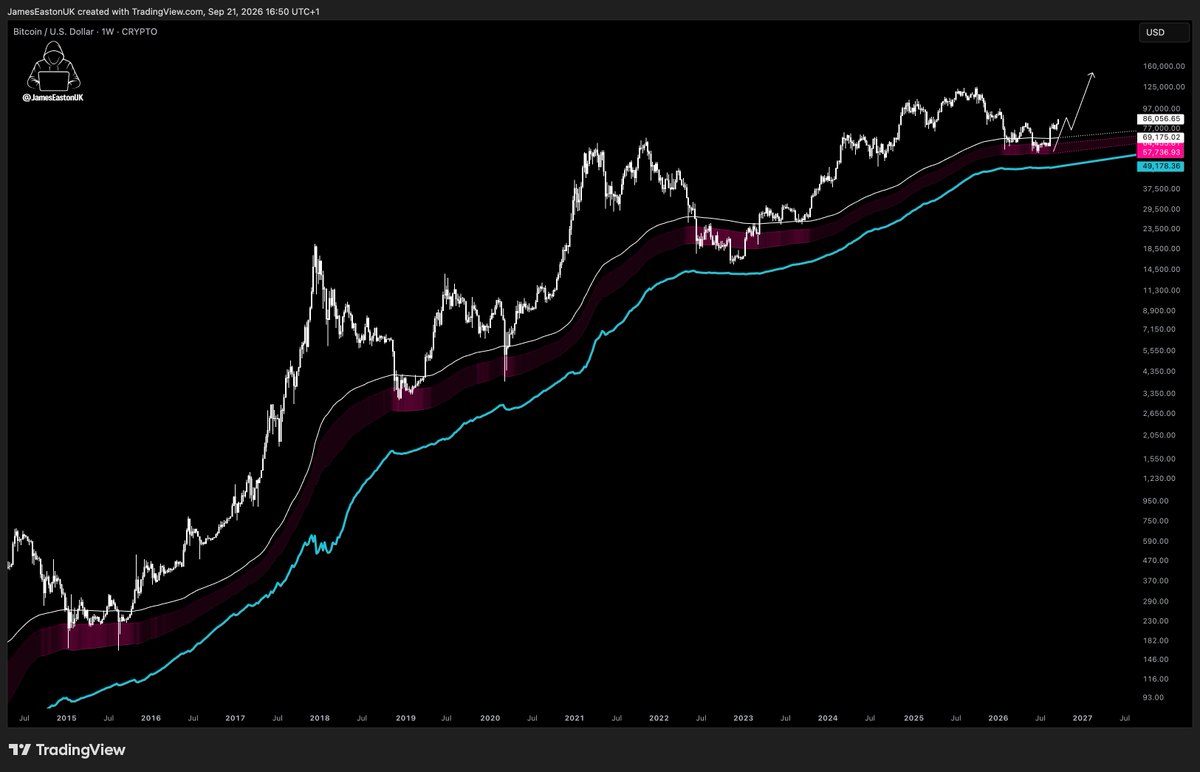
$BTC is closer to a drawdown like 2022 bottom than most people think. Yes we can go down more. But to buy spot and DCA here will likely be fruitful in 2027-2029.
Chart from @rektcapital https://t.co/FE7iHZHEgr
$BTC is closer to a drawdown like 2022 bottom than most people think. Yes we can go down more. But to buy spot and DCA here will likely be fruitful in 2027-2029.
Chart from @rektcapital https://t.co/FE7iHZHEgr
Hyperliquid whales still hold more short positions. https://t.co/ToSqNQjuC6
✖️1. Hyperliquid whales shift to a bullish stance
✅2. Bitfinex whales finish buying $BTC long positions
✖️3. The negative premium of the Kimchi Premium and the Coinbase Premium disappears
A rally begins when these three conditions are satisfied.
Currently, only one condition is satisfied. The bearish trend is still ongoing.
The biggest lesson from Bitcoin's history isn't that it always goes up it's that every cycle tests conviction.
The people who survived weren't the ones who could predict the future. They were the ones who understood the technology well enough not to confuse a market crash with a protocol failure.
Looking back, what looked like the end became one of Bitcoin's greatest buying opportunities.
How many people today would actually hold through another 90% drawdown?
TODAY IN HISTORY: MARKETS REMEMBER | JULY 30, 2026 | MORNING EDITION
Imagine buying Bitcoin... only to watch over 90% of your investment disappear in a matter of days.
On 30th July, 2011, the crypto world was still recovering from the catastrophic Mt. Gox hack. Mt. Gox, originally short for Magic: The Gathering Online eXchange, began as a website for trading game cards before transforming into the world's largest Bitcoin exchange, handling nearly 70% of all Bitcoin transactions at its peak.
Just weeks earlier, Bitcoin had surged to nearly $32. Then came the shock. A security breach at Mt. Gox triggered panic selling and shattered market confidence, sending Bitcoin crashing to around $2.
To many observers, Bitcoin was finished.
News outlets mocked it. Critics declared the experiment dead. Even some early believers walked away.
But history had other plans.
The network never stopped running. Developers kept building. A small community refused to quit.
Today, that crash is remembered not as Bitcoin's deat
Bitcoin (BTC) is a digital asset and a payment system invented by Satoshi Nakamoto who published a related paper in 2008 and released it as open-source software in 2009. The system featured as peer-to-peer; users can transact directly without an intermediary. Transactions are verified by network nodes and recorded in a public distributed ledger called the blockchain. The ledger uses bitcoin as its unit of account. The system works without a central repository or single administrator, which has led the U.S. Treasury to categorize bitcoin as a decentralized virtual currency. Bitcoin is often called the first cryptocurrency, although prior systems existed. Bitcoin is more correctly described as the first decentralized digital currency. It is the largest of its kind in terms of total market value by now.