Comprar cripto
tarjeta
Comercio P2P
Compra USDT en un marketplace
Tarjeta de crédito/débito
Compre criptomonedas con Visa o MasterCard
Pago vía prestadores
Compre criptomonedas a través de MoonPay, Simplex y más
Tarjeta BitMart
Impulsando su experiencia con las criptomonedas
Tarjeta prepago de criptomonedas
Obtenga una Mastercard lista para usar al instante
Comerciar
USDⓈ-M
Utilizando USDⓈ como colateral
COIN-M
Utilizando la propia moneda como colateral
TradFi
Trading integral para metales, acciones y forex
Operativa de demostración
Aprenda a operar con riesgo cero
Resumen de futuros
Plataforma única para todo lo relacionado con futuros
Rey de Futuros
Pool de premios de 478 000 USDT
Crecer
Resumen de Earn
Activos inactivos, gane con facilidad
Ahorros
Gane intereses conservando su portafolio.
Staking
Staking sencillo, cuantiosas retribuciones.
Gestión de patrimonio
Aumente su riqueza con un equipo de activos top
RWA
Mantenga BMRUSD, disfrute del rendimiento
Exclusivo VIP
Gane de forma estable para usuarios VIP
Rewards
Centro de recompensas
Descubra recompensas exclusivas por valor de hasta 14 000 USDT
LaunchPrime
Una plataforma para lanzar tokens y NFT
Programa de afiliados
Únase para ganar cuantiosas comisiones
Powerdrop
¡La solución AirDrop de próxima generación ya está AQUÍ!
Centro de eventos
El centro unificado para todas las operaciones de trading
Sorteo diario de futuros
100 % de probabilidades de ganar con operaciones diarias
Sorteo diario de Spot
Gane 8888 USDT en grandes premios
Recarga móvil
Recargue móviles de forma fácil, online y segura
Send
Send money globally, fast and secure
BitMart Mall
Viva de las criptomonedas

Bittensor Datos de precios en tiempo real
El precio de hoy de Bittensor es de $ 304.84 (TAO/USD). Con una capitalización de mercado de $ 3.52B USD. Volumen de trading en 24 horas de $ 394.54M USD, Un cambio de precio en 24 horas de -4.77%. Y un suministro circulante de 11.56M TAO.
Bittensor TAO Historial de precios USD
Siga el precio de Bittensor para hoy, 7 días, 30 días y 90 días
Periodo
Cambiar
Cambio (%)
Hoy
$ 15.25
-4.77%
7días
--
--
30días
--
--
90días
--
--
Sea propietario de TAO ahora
Compra y vende TAO fácil y seguro en BitMart.
Bittensor Información de mercado
$ 295.38 Autonomía de 24 horas $ 320.64
Máximo histórico
$ 0
El mínimo histórico
$ 0
Cambio en 24 h
-4.77%
Volumen en 24 h
$ 394,535,135.09
Suministros en circulación
11.53M
TAO
Market Cap
$ 3.52B
Suministro máximo
21.00M
TAO
Capitalización de mercado totalmente diluida
$ 6.40B
Trade TAO
Ganar
Pon a trabajar tus criptomonedas inactivas y obtén ingresos pasivos a través de ahorros, staking y más.
Bittensor X Insight

2xnmore
FA_Analyst
TA_Analyst
B
 45.5K @2xnmore
 Alcista
TAO is still at a low level; early positioning can avoid later chasing higher prices
2xnmore
FA_Analyst
TA_Analyst
B
45.5K @2xnmore Nobody rings a bell at the bottom.
$TAO is not loud right now. That is exactly the point.
The people who move before it makes sense are the ones who never have to chase it later.
This is still early. For now. https://t.co/FT4SuITGy2
 83
83
 8
8
 3.5K
3.5K
2026-08-03 15:37
Tendencia de TAO tras el lanzamiento
Alcista
TAO is still at a low level; early positioning can avoid later chasing higher prices

Flippix
TA_Analyst
Trader
A
3.8K @Flippix_sol Extremadamente alcista
After a period of absorption and shake‑out, the author predicts that TAO will experience a strong rally.
$TAO has been doing one thing for months.
Making people lose interest.
The hype disappeared.
The volatility faded.
Everyone moved on to the next shiny narrative.
And that’s usually when the market quietly starts preparing for its next move.
First came the expansion.
Then a long accumulation phase.
After that, months of manipulation that made it look like the trend was completely dead.
That’s exactly how strong trends often reset.
Not with excitement.
With boredom.
Now imagine what happens if buyers finally take control again.
The same people ignoring $TAO today will be chasing green candles a few months later.
Price doesn’t wait for the crowd.
The crowd waits for price.
If this structure plays out, the next expansion could be the strongest move we’ve seen since the last major rally.
The biggest opportunities almost never feel exciting at the bottom.
That’s why so few people are there before the move begins.
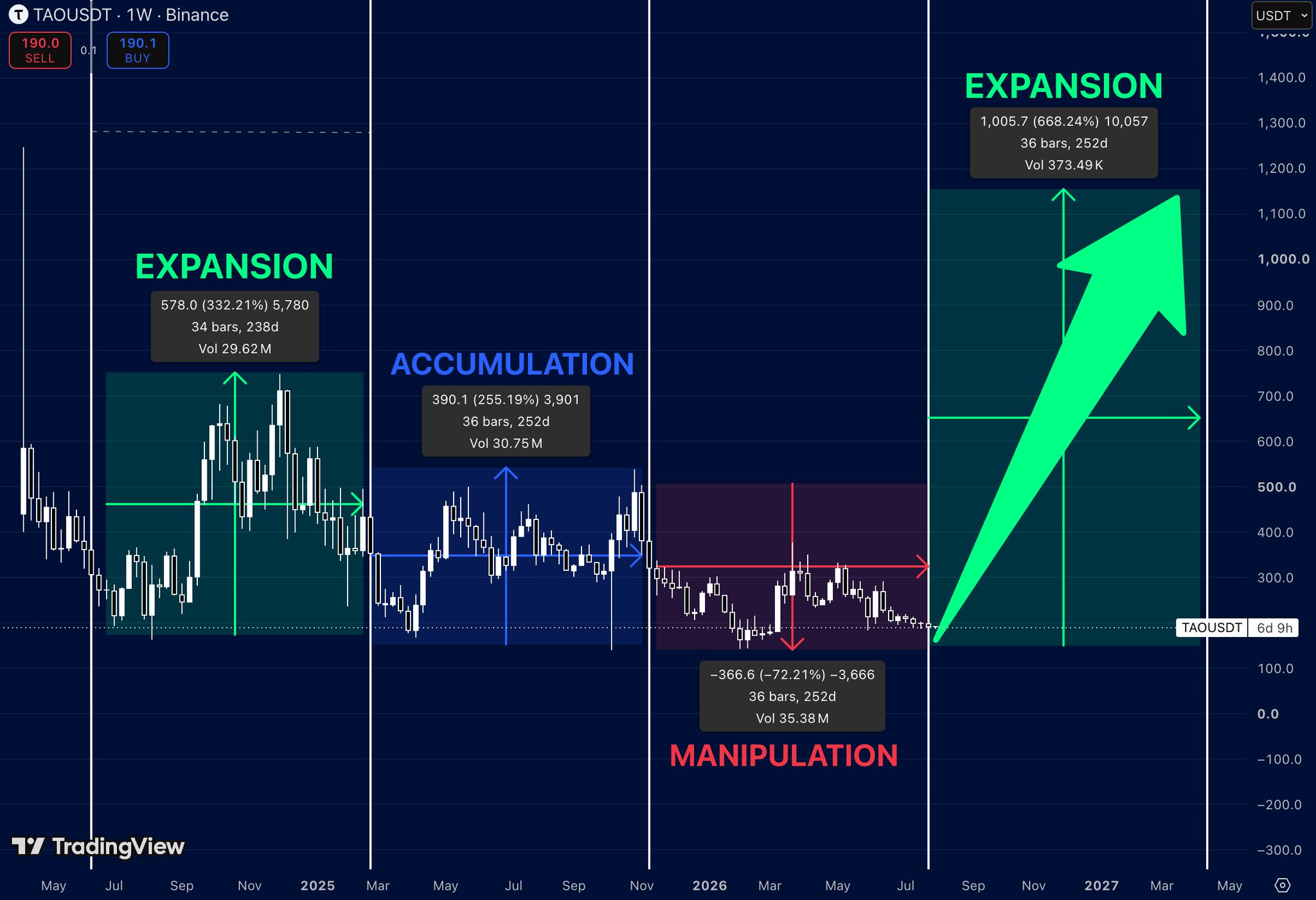 1
0
172
1
0
172
2026-08-03 15:08
Tendencia de TAO tras el lanzamiento
Extremadamente alcista
After a period of absorption and shake‑out, the author predicts that TAO will experience a strong rally.

Kyoshi.tao
Founder
Dev
A
1.6K @KyoshiTakeshiro Alcista
The tweet stresses that investing in Bittensor ecosystem projects requires due diligence and praises EnigmaSN63's innovative governance model.
Good to see more people doing actual due diligence before investing their bittensor:native into subnets.
Don’t just look for reasons to buy.
Look for reasons not to.
More often than not, you’ll find plenty.

Ragnarao (ᚱᚱ) D
919 @LordRagnarao My last post was really about project-specific risk.
The more I look around #Bittensor, the more I appreciate teams that spend as much time thinking about incentives and governance as they do the technology itself.
That’s what caught my attention about @EnigmaSN63.
Thank you, @Timmer56566787, for pointing me towards them!
They became the first subnet to implement the treasury wallet model, where prize funds are controlled by validator consensus instead of a single wallet. That makes large, winner-take-all research challenges possible without relying on trust in one operator.
It’s a clever way to fund deep‑tech research without asking participants to simply trust one team with the prize pool.
Whether I invest my $TAO or not is a separate question 😅
But I enjoy learning from projects like @EnigmaSN63 that experiment with governance mechanisms like this.
 1
0
101
1
0
101
2026-08-03 14:37
Tendencia de TAO tras el lanzamiento
Alcista
The tweet stresses that investing in Bittensor ecosystem projects requires due diligence and praises EnigmaSN63's innovative governance model.
Predicción de precios
¿Cuándo es un buen momento para comprar TAO? ¿Debería comprar o vender TAO ahora?
Al decidir si es un buen momento para comprar o vender Bittensor (TAO), es importante ajustarse primero a su propia estrategia de trading y perfil de riesgo. Los inversores a largo plazo y los traders a corto plazo suelen interpretar las condiciones del mercado de forma diferente, por lo que su decisión debe reflejar su enfoque personal. Según el último análisis técnico de 4 horas de TAO, la señal de trading actual es Hold.

Predicción de Beacon
Pronóstico probabilístico de precios (próximas 24 horas)Descargo de responsabilidad de la predicción de Beacon
Los resultados de los datos que se muestran en esta página se analizan en función de los datos de trading reales (OHLCV) del par de trading seleccionado junto con los indicadores técnicos correspondientes.
Esta predicción es un producto técnico experimental y se proporciona solo con fines de referencia. No constituye un consejo de inversión. Los acontecimientos inesperados del mundo real pueden influir significativamente en el comportamiento del mercado. Por tanto, los traders deben tomar decisiones con precaución.
Esta predicción es un producto técnico experimental y se proporciona solo con fines de referencia. No constituye un consejo de inversión. Los acontecimientos inesperados del mundo real pueden influir significativamente en el comportamiento del mercado. Por tanto, los traders deben tomar decisiones con precaución.
Sobre Bittensor
Bittensor (TAO) is a cryptocurrency launched in 2021and operates on the Bittensor platform. Bittensor has a current supply of 21,000,000 with 11,559,295.59934163 in circulation. The last known price of Bittensor is 312.6581042 USD and is down -2.91 over the last 24 hours. It is currently trading on 332 active market(s) with $315,655,484.69 traded over the last 24 hours. More information can be found at https://bittensor.com.
Leer más
Enlaces oficiales
Redes sociales
Explorador de blockchain
Comprar TAO
Trade TAO