Comprar cripto
tarjeta
Comercio P2P
Compra USDT en un marketplace
Tarjeta de crédito/débito
Compre criptomonedas con Visa o MasterCard
Pago vía prestadores
Compre criptomonedas a través de MoonPay, Simplex y más
Tarjeta BitMart
Impulsando su experiencia con las criptomonedas
Tarjeta prepago de criptomonedas
Obtenga una Mastercard lista para usar al instante
Comerciar
USDⓈ-M
Utilizando USDⓈ como colateral
COIN-M
Utilizando la propia moneda como colateral
TradFi
Trading integral para metales, acciones y forex
Operativa de demostración
Aprenda a operar con riesgo cero
Resumen de futuros
Plataforma única para todo lo relacionado con futuros
Rey de Futuros
Pool de premios de 478 000 USDT
Crecer
Resumen de Earn
Activos inactivos, gane con facilidad
Ahorros
Gane intereses conservando su portafolio.
Staking
Staking sencillo, cuantiosas retribuciones.
Gestión de patrimonio
Aumente su riqueza con un equipo de activos top
RWA
Mantenga BMRUSD, disfrute del rendimiento
Exclusivo VIP
Gane de forma estable para usuarios VIP
Rewards
Centro de recompensas
Descubra recompensas exclusivas por valor de hasta 14 000 USDT
LaunchPrime
Una plataforma para lanzar tokens y NFT
Programa de afiliados
Únase para ganar cuantiosas comisiones
Powerdrop
¡La solución AirDrop de próxima generación ya está AQUÍ!
Centro de eventos
El centro unificado para todas las operaciones de trading
Sorteo diario de futuros
100 % de probabilidades de ganar con operaciones diarias
Sorteo diario de Spot
Gane 8888 USDT en grandes premios
Recarga móvil
Recargue móviles de forma fácil, online y segura
Send
Send money globally, fast and secure
BitMart Mall
Viva de las criptomonedas

Sign (SIGN)
$ 0.0067 (SIGN/USD)
3.37%
24H
Sign Datos de precios en tiempo real
El precio de hoy de Sign es de $ 0.0067 (SIGN/USD). Con una capitalización de mercado de $ 16.09M USD. Volumen de trading en 24 horas de $ 3.67M USD, Un cambio de precio en 24 horas de +3.37%. Y un suministro circulante de 2.39B SIGN.
Sign SIGN Historial de precios USD
Siga el precio de Sign para hoy, 7 días, 30 días y 90 días
Periodo
Cambiar
Cambio (%)
Hoy
$ 0.00021
3.37%
7días
$ 0.00029
-4.40%
30días
$ 0.0018
-22.29%
90días
$ 0.0034
-34.80%
Sea propietario de SIGN ahora
Compra y vende SIGN fácil y seguro en BitMart.
Sign Información de mercado
$ 0.0064 Autonomía de 24 horas $ 0.0068
Máximo histórico
$ 0.059
El mínimo histórico
$ 0.0062
Cambio en 24 h
3.37%
Volumen en 24 h
$ 3,665,704.05
Suministros en circulación
2.38B
SIGN
Market Cap
$ 16.09M
Suministro máximo
10.00B
SIGN
Capitalización de mercado totalmente diluida
$ 67.43M
Trade SIGN
Ganar
Pon a trabajar tus criptomonedas inactivas y obtén ingresos pasivos a través de ahorros, staking y más.
Sign X Insight

Krahs🦈☂️Solstice✨
Community_Lead
Media
B
 3.4K @pc970930
 Neutral
Sign will host a Korean AMA in July, sharing the latest developments and answering questions.

코인소년 COINBOY🦅 D
17.8K @coinboy717 CoinBoy X Sign July AMA (conducted in Korean)
https://t.co/4LpXj1bnny
"Sharing recent Sign updates & answering your questions"
 36
36
 12
12
 976
976
2026-07-23 11:37
Tendencia de SIGN tras el lanzamiento
Neutral
Sign will host a Korean AMA in July, sharing the latest developments and answering questions.

Xin
Founder
Regulatory_Expert
B
19.4K @realyanxin Alcista
SIGN launches soft-start forward claim market

Sign D
280.4K @Sign Forward Claim is now live in soft launch.
Locked $SIGN can now be listed and sold before it unlocks.
A dedicated forward market for vesting allocations.
Sellers list. Buyers buy. We settle daily.
🔗 https://t.co/qyujxbWUzo
48
10
9.1K
2026-07-18 14:37
Tendencia de SIGN tras el lanzamiento
Alcista
SIGN launches soft-start forward claim market

Crypto Solutions 🕊️
Founder
DeFi_Expert
C
40.0K @creptosolutions Alcista
SIGN team adjusts token unlock plan, aiming to reduce sell pressure and promote long‑term health.
This is a thoughtful move by the SIGN team. Rather than letting monthly unlocks create constant sell pressure, they've restructured the schedule into more manageable liquidity events without extending the overall vesting timeline or giving anyone preferential treatment.
Managing tokenomics after launch is never easy, especially when market conditions are unpredictable. Credit to the team for listening to stakeholders, staying transparent, and making a decision aimed at supporting long-term ecosystem health. That's the kind of execution that builds confidence over time.
Sign D
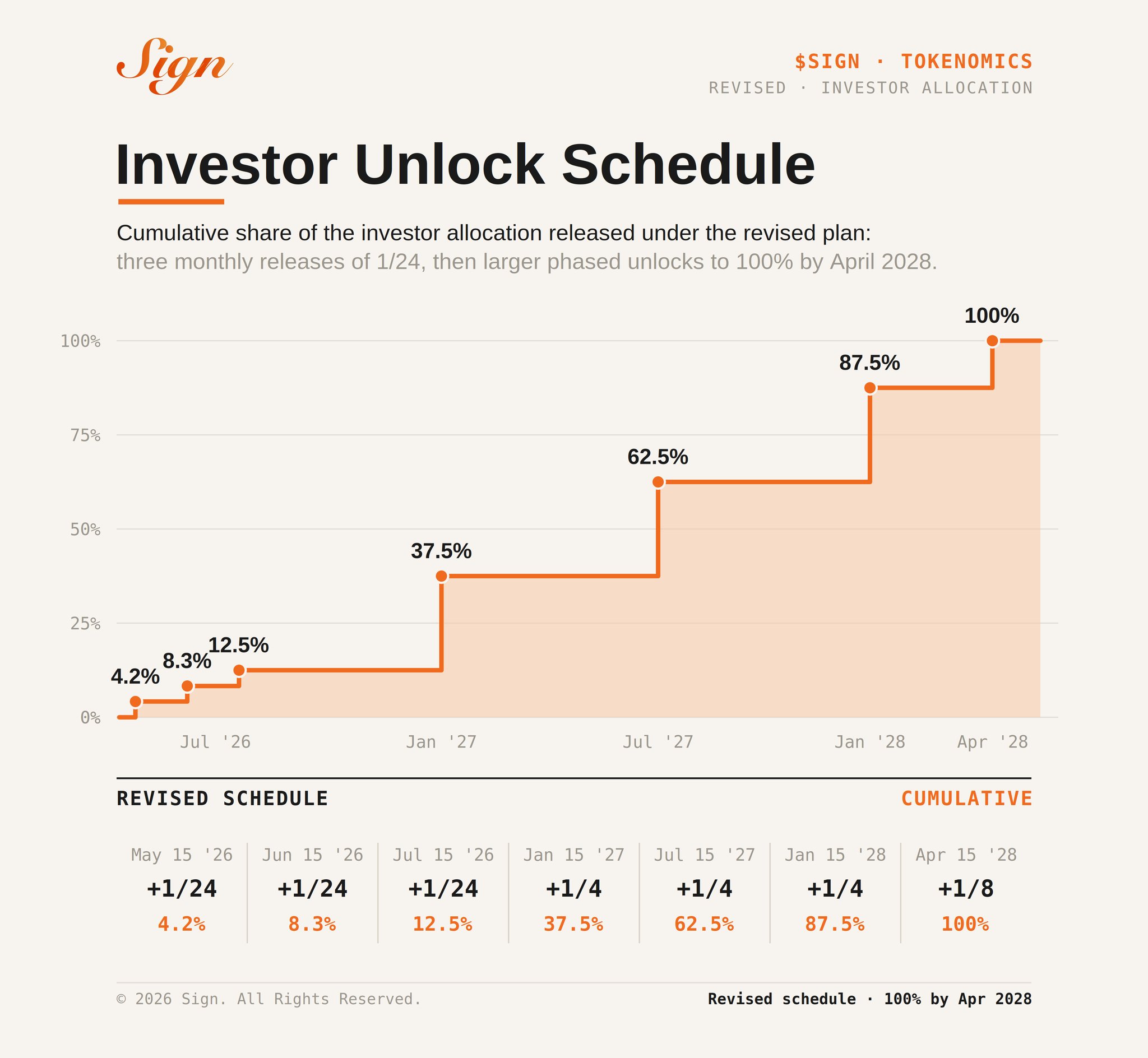
280.4K @Sign Following consensus from Sign Foundation and the majority of our backers, we are updating the $SIGN token unlock schedule.
The first three unlocks remain unchanged: 1/24 monthly through July 2026.
After that, unlocks will move into spaced tranches:
• Jan 15, 2027: 1/4
• Jul 15, 2027: 1/4
• Jan 15, 2028: 1/4
• Apr 15, 2028: final 1/8
The revised schedule is being synced to CoinMarketCap
https://t.co/3G87styC64
All investor and early contributor tokens remain fully unlocked by April 15, 2028. This is a timing restructure, not an extension. There is no preferential acceleration.
The purpose is to reduce continuous monthly overhang and turn unlocks into managed liquidity events aligned with stronger business and market windows.
We are also launching Forward Claim, a dedicated venue for locked tokens, allowing eligible holders to rebalance through an OTC-style forward market without impacting spot liquidity.
More details will follow.
 6
1
1.9K
6
1
1.9K
2026-07-02 17:37
Tendencia de SIGN tras el lanzamiento
Alcista
SIGN team adjusts token unlock plan, aiming to reduce sell pressure and promote long‑term health.
Predicción de precios
¿Cuándo es un buen momento para comprar SIGN? ¿Debería comprar o vender SIGN ahora?
Al decidir si es un buen momento para comprar o vender Sign (SIGN), es importante ajustarse primero a su propia estrategia de trading y perfil de riesgo. Los inversores a largo plazo y los traders a corto plazo suelen interpretar las condiciones del mercado de forma diferente, por lo que su decisión debe reflejar su enfoque personal. Según el último análisis técnico de 4 horas de SIGN, la señal de trading actual es Vender. Según el último análisis técnico de 1 día de SIGN, la señal actual es Hold.

Predicción de Beacon
Pronóstico probabilístico de precios (próximas 24 horas)Descargo de responsabilidad de la predicción de Beacon
Los resultados de los datos que se muestran en esta página se analizan en función de los datos de trading reales (OHLCV) del par de trading seleccionado junto con los indicadores técnicos correspondientes.
Esta predicción es un producto técnico experimental y se proporciona solo con fines de referencia. No constituye un consejo de inversión. Los acontecimientos inesperados del mundo real pueden influir significativamente en el comportamiento del mercado. Por tanto, los traders deben tomar decisiones con precaución.
Esta predicción es un producto técnico experimental y se proporciona solo con fines de referencia. No constituye un consejo de inversión. Los acontecimientos inesperados del mundo real pueden influir significativamente en el comportamiento del mercado. Por tanto, los traders deben tomar decisiones con precaución.
Sobre Sign
Sign (SIGN) is a cryptocurrency launched in 2025and operates on the Ethereum platform. Sign has a current supply of 10,000,000,000 with 2,386,666,666 in circulation. The last known price of Sign is 0.00694338 USD and is up 1.39 over the last 24 hours. It is currently trading on 186 active market(s) with $3,969,713.67 traded over the last 24 hours. More information can be found at https://sign.global/.
Leer más
Enlaces oficiales
Explorador de blockchain