
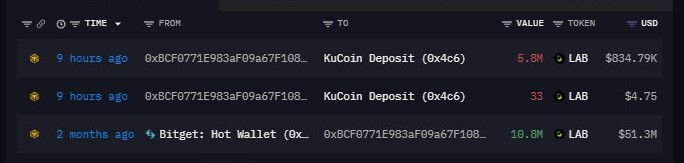
Wu said he learned that, according to monitoring by @ai_9684xtpa, an address suspected of being related to an insider of LAB transferred 5.8 million LAB to KuCoin about 9 hours ago, worth approximately $834,000. Subsequently, LAB fell from $0.1439 to $0.1273, a decline of about 11.5%. The entity still holds about 74.7 million LAB, valued at roughly $10.11 million.
https://t.co/ZtKvmAC1xu
Comprar cripto
tarjeta
Comercio P2P
Compra USDT en un marketplace
Tarjeta de crédito/débito
Compre criptomonedas con Visa o MasterCard
Pago vía prestadores
Compre criptomonedas a través de MoonPay, Simplex y más
Tarjeta BitMart
Impulsando su experiencia con las criptomonedas
Tarjeta prepago de criptomonedas
Obtenga una Mastercard lista para usar al instante
Comerciar
USDⓈ-M
Utilizando USDⓈ como colateral
COIN-M
Utilizando la propia moneda como colateral
TradFi
Trading integral para metales, acciones y forex
Operativa de demostración
Aprenda a operar con riesgo cero
Resumen de futuros
Plataforma única para todo lo relacionado con futuros
Rey de Futuros
Pool de premios de 478 000 USDT
Crecer
Resumen de Earn
Activos inactivos, gane con facilidad
Ahorros
Gane intereses conservando su portafolio.
Staking
Staking sencillo, cuantiosas retribuciones.
Gestión de patrimonio
Aumente su riqueza con un equipo de activos top
RWA
Mantenga BMRUSD, disfrute del rendimiento
Exclusivo VIP
Gane de forma estable para usuarios VIP
Rewards
Centro de recompensas
Descubra recompensas exclusivas por valor de hasta 14 000 USDT
LaunchPrime
Una plataforma para lanzar tokens y NFT
Programa de afiliados
Únase para ganar cuantiosas comisiones
Powerdrop
¡La solución AirDrop de próxima generación ya está AQUÍ!
Centro de eventos
El centro unificado para todas las operaciones de trading
Sorteo diario de futuros
100 % de probabilidades de ganar con operaciones diarias
Sorteo diario de Spot
Gane 8888 USDT en grandes premios
Recarga móvil
Recargue móviles de forma fácil, online y segura
Send
Send money globally, fast and secure
BitMart Mall
Viva de las criptomonedas
The Professor LAB Historial de precios USD
Siga el precio de The Professor para hoy, 7 días, 30 días y 90 días
Periodo
Cambiar
Cambio (%)
Hoy
--
--
7días
--
--
30días
--
--
90días
--
--
Sea propietario de LAB ahora
Compra y vende LAB fácil y seguro en BitMart.
The Professor Información de mercado
$ 0.0000099 Autonomía de 24 horas $ 0.000019
Máximo histórico
$ 0
El mínimo histórico
$ 0
Cambio en 24 h
Volumen en 24 h
0
Suministros en circulación
230.40M
LAB
Market Cap
0
Suministro máximo
1.00B
LAB
Capitalización de mercado totalmente diluida
0
Trade LAB
Ganar
Pon a trabajar tus criptomonedas inactivas y obtén ingresos pasivos a través de ahorros, staking y más.
The Professor X Insight

吴说区块链
Media
Influencer
D
 179.0K @wublockchain12
 Extremadamente bajista
LAB dropped to $0.1273 after moving to KuCoin, a decline of 11.5%
 0
0
 2
2
 5.8K
5.8K
2026-08-02 03:17
Tendencia de LAB tras el lanzamiento
Bajista
LAB dropped to $0.1273 after moving to KuCoin, a decline of 11.5%

EyeOnChain
OnChain_Analyst
Media
D
6.0K @EyeOnChain Bajista
LAB可疑内部钱包向KuCoin转账83.4万美元,引发11.5%跌幅,历史数据显示此行为常导致币价下跌。
Really a curse on $LAB , The LAB insider wallet is active again🥶.
After nearly three weeks of inactivity, the suspected LAB insider has started moving tokens once more.
Around 9 hours ago, the wallet deposited 5.8M LAB, worth approximately $834K, into KuCoin at an average deposit price of $0.1439. Not long after the transfer, #LAB came under selling pressure, dropping from $0.1439 to a low of $0.1273 over the next 90 minutes -- a decline of roughly 11.5%.
Address: 0xBCF0771E983aF09a67F10812fB336731e4C5D688 .
Once again raised questions, as exchange deposits from this wallet have previously been followed by sharp price declines.
 2
0
716
2
0
716
2026-08-02 03:12
Tendencia de LAB tras el lanzamiento
Extremadamente bajista
LAB可疑内部钱包向KuCoin转账83.4万美元,引发11.5%跌幅,历史数据显示此行为常导致币价下跌。
吴说区块链
Media
Influencer
D
179.0K @wublockchain12 Extremadamente bajista
After a large LAB transfer, price fell to $0.1273, short-term bearish.
Wu said he learned,
According to monitoring by @ai_9684xtpa, an address suspected of being related to the LAB insider transferred 5.8 million LAB to KuCoin about 9 hours ago, worth about $834,000. Afterwards LAB fell from $0.1439 to $0.1273, a drop of about 11.5%. The entity still holds about 74.7 million LAB, valued at roughly $10.11 million.
https://t.co/ZtKvmAC1xu
0
0
889
2026-08-02 02:47
Tendencia de LAB tras el lanzamiento
Bajista
After a large LAB transfer, price fell to $0.1273, short-term bearish.
Sobre The Professor
The Professor (LAB) is a cryptocurrency launched in 2024and operates on the Solana platform. The Professor has a current supply of 1,000,000,000 with 0 in circulation. The last known price of The Professor is 0.00001462 USD and is up 0.00 over the last 24 hours. More information can be found at https://madlabsol.io/.
Leer más
Enlaces oficiales
Redes sociales
Explorador de blockchain
Comprar LAB
Trade LAB