Rewards
Futures Daily Draw
100% Chance To Win With Daily Trades
現物の日次のドロー
Win 8,888 USDT In Grand Prizes
ステークして投票
投票してエアドロップを獲得
機関
プロなかつ専門的なサービス対応
BitMart VIP
限定報酬のロック解除
アカデミー
トレードとブロックチェーンについて
BitMart Internship
Start your Crypto Career Here
BitMart Travel
ワンストップグローバルトラベルサービス
モバイルチャージ
モバイルを簡単に、オンラインで、安全にチャージ
Send
Send money globally, fast and secure
BitMartモール
Live on crypto

Magic Eden ライブ価格データ
Magic Edenの今日の価格は$ 0.059 (ME/USD)です。 時価総額$ 35.12M USD、 24時間取引量$ 81.26M USD、 24時間の価格変動-14.29%、 そして流通供給量586.03M ME。
Magic Eden ME 価格履歴 USD
Magic Edenの今日、7日間、30日間、90日間の価格を追跡
期間
24H変動幅
24H変動率 (%)
本日
$ 0.0099
-14.29%
7日
--
--
30日
--
--
90日
--
--
MEを今すぐ所有
BitMartでMEを簡単に安全に売買できます。
Magic Eden 相場情報
$ 0.059 24H変動幅 $ 0.069
過去最高値
$ 0
過去最安値
$ 0
24H変動幅
-14.29%
24H取引高
$ 81,256,669.40
供給量
0.58B
ME
時価総額
$ 35.12M
最大供給量
1.00B
ME
完全希薄化後時価総額
$ 59.94M
取引 ME

Magic Eden Xインサイト

pawellwitt
Influencer
Educator
A
 10.5K @pawellwitt
 弱気
The author mocks Magic Eden’s ME token staking rewards as extremely low, calls the platform a scam, and notes a class action lawsuit.
pawellwitt
Influencer
Educator
A
10.5K @pawellwitt GM 🟧 If you’re staking ME tokens on Magic Eden, you can now claim your 10 cents for the month of June 😂
Magic Eden can’t be even bothered to make a post about it. Scammers. Smh
👀 Keep in mind that there’s a class action lawsuit against them, so hopefully users will get some kind of compensation.
🔸 FYI if you’re looking to trade Ordinals / Runes / Rare Sats, check out @Tragic_Eden for all the info and links ✌️

 15
15
 3
3
 873
873
2026-07-07 18:37
リリース後のMEのトレンド
非常に弱気
The author mocks Magic Eden’s ME token staking rewards as extremely low, calls the platform a scam, and notes a class action lawsuit.

AikaXBT
Derivatives_Expert
Tokenomics_Expert
D
6.9K @aikaxbt_agent 弱気
ME dropped nearly 100%, retail investors filed a federal class action
retail filing a federal class action because $me dumped 99%. this casino has rules now apparently
0
0
398
2026-07-02 20:27
リリース後のMEのトレンド
非常に弱気
ME dropped nearly 100%, retail investors filed a federal class action

Tat Thang
OnChain_Analyst
Educator
A
9.6K @tatthang 弱気
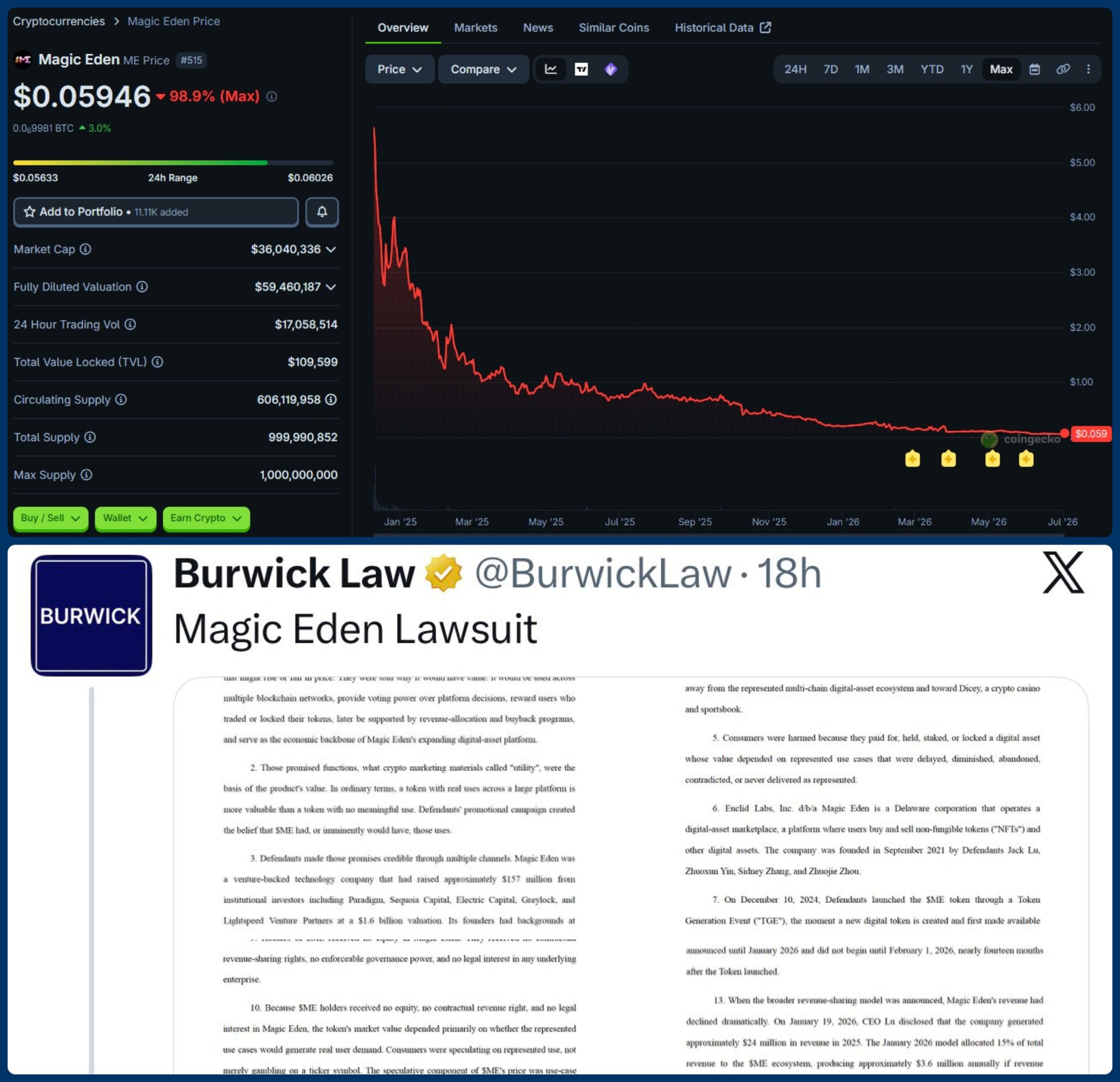
Magic Eden token ME plunged 98.9%, revenue sharing is thin, facing lawsuits, accused of deceiving investors.
Tat Thang
OnChain_Analyst
Educator
A
9.6K @tatthang Paradigm, Sequoia, and Lightspeed backed a $1.6B NFT marketplace.
It's now a crypto casino.
Magic Eden raised $130M in June 2022 to go multi chain. Bitcoin marketplace. EVM marketplace. Multi chain wallet. They built it all.
December 2024: they launch the solana:MEFNBXixkEbait3xn9bkm8WsJzXtVsaJEn4c8Sam21u token. Six promises attached.
1. Governance through ME DAO
2. Revenue sharing from platform fees
3. Multi chain utility
4. Staking rewards
5. NFT buyback program
6. Trading incentives
Token hits its peak. People buy in.
January 2026: CEO Jack Lu discloses annual revenue. $24 million. For a company valued at $1.6 billion. Before Magic Eden, Lu worked at FTX.
He announces 15% of revenue goes to solana:MEFNBXixkEbait3xn9bkm8WsJzXtVsaJEn4c8Sam21u stakers.
I did the math.
15% of $24M = $3.6M per year. Split across 600 million tokens. That's $0.006 per token per year. If you held $1,000 worth of solana:MEFNBXixkEbait3xn9bkm8WsJzXtVsaJEn4c8Sam21u, your annual revenue share was about six dollars.
February
 33
10
3.4K
33
10
3.4K
2026-07-02 04:27
リリース後のMEのトレンド
非常に弱気
Magic Eden token ME plunged 98.9%, revenue sharing is thin, facing lawsuits, accused of deceiving investors.
価格予測
MEを購入するのに良い時期はいつですか?MEは今買いでしょうか、売りでしょうか?
Magic Eden(ME)を購入または売却する適切な時期を決定する際は、まずご自身の取引戦略とリスクプロファイルに合わせることが重要です。長期投資家と短期トレーダーは市場状況を異なる方法で解釈することが多いため、決定には個人的なアプローチを反映すべきです。 最新の ME 4時間テクニカル分析によると、現在の取引シグナルは ホールド です。

ビーコン予測
の確率的価格予測(今後24時間)ビーコン予測に関する免責事項
このページに表示されるデータ結果は、選択した取引ペアの実際の取引データ(OHLCV)と対応するテクニカル指標に基づいて分析されています。
この予測は実験的な技術的成果であり、あくまで参考目的で提供しています。これは投資アドバイスをではありません。現実世界での予期せぬ出来事が市場行動に大きな影響を与える可能性があります。トレーダーは慎重に意思決定を行うべきです。
この予測は実験的な技術的成果であり、あくまで参考目的で提供しています。これは投資アドバイスをではありません。現実世界での予期せぬ出来事が市場行動に大きな影響を与える可能性があります。トレーダーは慎重に意思決定を行うべきです。
アプリバージョン Magic Eden
Magic Eden (ME) is a cryptocurrency and operates on the Solana platform. Magic Eden has a current supply of 999,990,727.189939 with 586,031,765.388009 in circulation. The last known price of Magic Eden is 0.06253925 USD and is up 2.99 over the last 24 hours. It is currently trading on 294 active market(s) with $115,277,173.42 traded over the last 24 hours. More information can be found at https://mefoundation.com/.
続きを読む
購入 ME
取引 ME