Купити криптовалюту
Картка
P2P-торгівля
Купуйте USDT через маркетплейс
Кредитна/дебетова картка
Купуйте криптовалюту за допомогою Visa або MasterCard
Платіж третьої сторони
Купуйте криптовалюту через MoonPay, Simplex та інші сервіси
Картка BitMart
Розширення можливостей вашого криптожиття
Передплачена криптовалютна картка
Миттєво отримайте картку Mastercard для витрат
Торгувати
USDⓈ-M
Використання USDⓈ в якості застави
COIN-M
Використання самої COIN в якості застави
TradFi
Єдине місце для торгівлі металами, акціями та іноземною валютою
Демоторгівля
Дізнайтеся, як торгувати без ризику
Огляд ф'ючерсів
Універсальна платформа для всього, що стосується ф'ючерсів
Futures King
Призовий фонд 478 000 USDT
Примножити
Детальніше про Earn
Заробляйте на невикористаних активах із легкістю
Заощадження
Заробляйте на холдингу.
Стейкінг
Легка ставка, висока винагорода.
Управління капіталом
Примножуйте свій капітал із допомогою провідної команди в галузі управління активами
RWA
Утримуйте BMRUSD — отримуйте дохід
VIP-ексклюзив
Стабільно заробляйте для VIP-користувачів
AI Hub
Rewards
Щоденний розіграш ф’ючерсів
100% шанс на перемогу на щоденних угодах
Щоденний спотовий розіграш
Виграйте головний приз — до 8 888 USDT
Ставка для голосування
Заробіть айрдропи, проголосувавши
Установа
Професійні та ексклюзивні послуги
VIP
Розблокуйте ексклюзивні винагороди
Академія
Швидко дізнайтеся про трейдинг та блокчейн
BitMart Internship
Start your Crypto Career Here
Bitmart подорожі
Універсальні глобальні туристичні послуги
Поповнення мобільного
Швидке і безпечне поповнення мобільного онлайн
Send
Send money globally, fast and secure
BitMart Mall
Заробляйте криптовалюту

Sign (SIGN)
$ 0.0067 (SIGN/USD)
3.37%
24H
Sign Дані про ціни в реальному часі
Поточна ціна Sign становить $ 0.0067 (SIGN/USD). З ринковою капіталізацією $ 16.09M USD. Обсяг торгів за 24 години: $ 3.67M USD, Зміна ціни за 24 години: +3.37%, І циркулююча пропозиція: 2.39B SIGN.
Sign SIGN Історія зміни цін USD
Відстежуйте зміну ціни Sign за сьогодні та за 7, 30 і 90 днів
Період
Змінити
Зміна (%)
Сьогодні
$ 0.00021
3.37%
7днів
$ 0.00029
-4.40%
30днів
$ 0.0018
-22.29%
90днів
$ 0.0034
-34.80%
Стати власником SIGN зараз
Купуйте та продавайте SIGN легко та безпечно на BitMart.
Sign Інформація про ринок
$ 0.0064 24-годинний діапазон $ 0.0068
Найвищий показник за весь час
$ 0.059
Найнижчий показник за весь час
$ 0.0062
24-годинна зміна
3.37%
24г Vol
$ 3,665,704.05
Циркуляційний запас
2.38B
SIGN
Ринкова капіталізація
$ 16.09M
Максимальна пропозиція
10.00B
SIGN
Повністю розбавлена ринкова капіталізація
$ 67.43M
Торгувати SIGN
Заробити
Залучайте неактивну криптовалюту до роботи та легко отримуйте пасивний дохід через заощадження, стейкінг та інші послуги.
Sign X Інсайт

Krahs🦈☂️Solstice✨
Community_Lead
Media
B
 3.4K @pc970930
 Нейтральні
Sign will host a Korean AMA in July, sharing the latest developments and answering questions.

코인소년 COINBOY🦅 D
17.8K @coinboy717 CoinBoy X Sign July AMA (conducted in Korean)
https://t.co/4LpXj1bnny
"Sharing recent Sign updates & answering your questions"
 36
36
 12
12
 976
976
2026-07-23 11:37
Тенденція SIGN після випуску
Нейтральні
Sign will host a Korean AMA in July, sharing the latest developments and answering questions.

Xin
Founder
Regulatory_Expert
B
19.4K @realyanxin Бичачий
SIGN launches soft-start forward claim market

Sign D
280.4K @Sign Forward Claim is now live in soft launch.
Locked $SIGN can now be listed and sold before it unlocks.
A dedicated forward market for vesting allocations.
Sellers list. Buyers buy. We settle daily.
🔗 https://t.co/qyujxbWUzo
48
10
9.1K
2026-07-18 14:37
Тенденція SIGN після випуску
Бичачий
SIGN launches soft-start forward claim market

Crypto Solutions 🕊️
Founder
DeFi_Expert
C
40.0K @creptosolutions Бичачий
SIGN team adjusts token unlock plan, aiming to reduce sell pressure and promote long‑term health.
This is a thoughtful move by the SIGN team. Rather than letting monthly unlocks create constant sell pressure, they've restructured the schedule into more manageable liquidity events without extending the overall vesting timeline or giving anyone preferential treatment.
Managing tokenomics after launch is never easy, especially when market conditions are unpredictable. Credit to the team for listening to stakeholders, staying transparent, and making a decision aimed at supporting long-term ecosystem health. That's the kind of execution that builds confidence over time.
Sign D
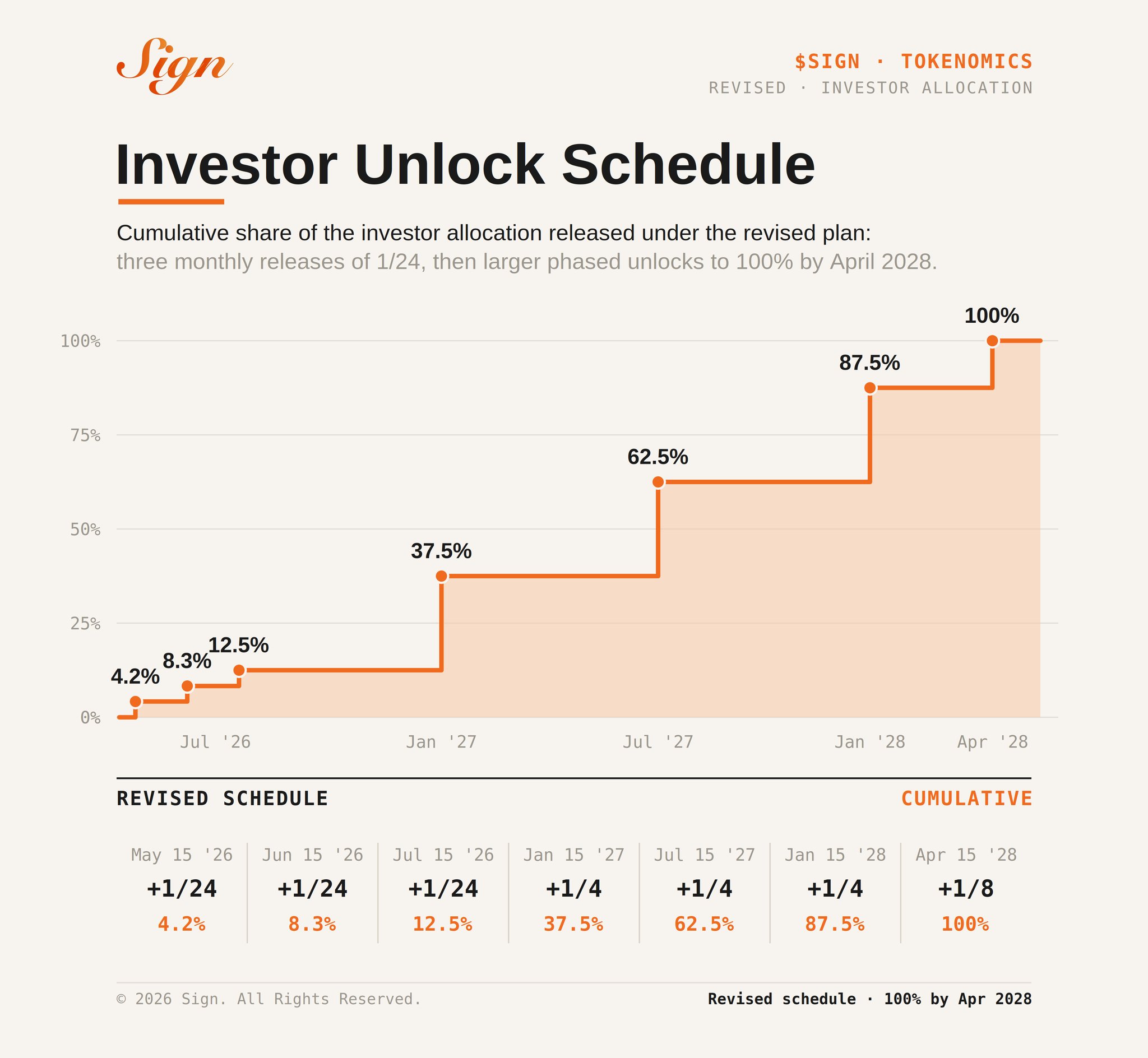
280.4K @Sign Following consensus from Sign Foundation and the majority of our backers, we are updating the $SIGN token unlock schedule.
The first three unlocks remain unchanged: 1/24 monthly through July 2026.
After that, unlocks will move into spaced tranches:
• Jan 15, 2027: 1/4
• Jul 15, 2027: 1/4
• Jan 15, 2028: 1/4
• Apr 15, 2028: final 1/8
The revised schedule is being synced to CoinMarketCap
https://t.co/3G87styC64
All investor and early contributor tokens remain fully unlocked by April 15, 2028. This is a timing restructure, not an extension. There is no preferential acceleration.
The purpose is to reduce continuous monthly overhang and turn unlocks into managed liquidity events aligned with stronger business and market windows.
We are also launching Forward Claim, a dedicated venue for locked tokens, allowing eligible holders to rebalance through an OTC-style forward market without impacting spot liquidity.
More details will follow.
 6
1
1.9K
6
1
1.9K
2026-07-02 17:37
Тенденція SIGN після випуску
Бичачий
SIGN team adjusts token unlock plan, aiming to reduce sell pressure and promote long‑term health.
Прогноз ціни
Чи зараз слушний час для покупки SIGN? Чи варто зараз купувати або продавати SIGN?
Вирішуючи, чи вдалий зараз час для купівлі або продажу Sign (SIGN), важливо спочатку узгодити свою торгову стратегію та профіль ризику.Довгострокові інвестори та короткострокові трейдери часто по-різному інтерпретують ринкові умови, тому ваше рішення має відображати ваш особистий підхід. Згідно з останнім 4-годинним технічним аналізом SIGN, поточний торговий сигнал — Продати. Згідно з останнім 1-денним технічним аналізом SIGN, поточний сигнал — Утримувати.

Прогноз Beacon
Ймовірний прогноз ціни (на найближчі 24 години)Відмова від відповідальності щодо передбачення Beacon
Результати даних, відображені на цій сторінці, аналізуються на основі фактичних торгових даних (OHLCV) обраної торгової пари разом із відповідними технічними показниками.
Цей прогноз є експериментальним технічним продуктом і надається лише для довідки. Він не є інвестиційною порадою. Несподівані події в реальному світі можуть суттєво вплинути на поведінку ринку. Трейдерам слід приймати рішення з обережністю.
Цей прогноз є експериментальним технічним продуктом і надається лише для довідки. Він не є інвестиційною порадою. Несподівані події в реальному світі можуть суттєво вплинути на поведінку ринку. Трейдерам слід приймати рішення з обережністю.
Про Sign
Sign (SIGN) is a cryptocurrency launched in 2025and operates on the Ethereum platform. Sign has a current supply of 10,000,000,000 with 2,386,666,666 in circulation. The last known price of Sign is 0.00694338 USD and is up 1.39 over the last 24 hours. It is currently trading on 186 active market(s) with $3,969,713.67 traded over the last 24 hours. More information can be found at https://sign.global/.
Читати більше
Офіційні посилання
Дослідник ланцюга