


The key shift: it’s not tokens that are competing, but payment stacks.
The winner won’t be the most high-profile launch, but the stack that can move money through the “fiat → settlement → money again” process with clear compliance and custody.
活動
合約每日抽獎
每日交易100%中獎
現貨每日抽獎
抽 8,888 USDT 豪禮
投票上幣
投票支持區塊鏈資產,賺取空投
機構
專為機構打造的解決方案
VIP
解鎖專屬福利
BitMart 學院
快速學習入門交易,瞭解區塊鏈知識
BitMart 大使
學習、建設 Web3,從 BitMart 起航
BitMart Travel
全球旅行服務,一站式預訂
BitMart話費充值
話費、流量、套餐便攜充值
轉帳
安全便捷,隨時隨地全球匯款
幣市商城
用加密貨幣滿足您的一切消費需求
PayPal USD 實時價格數據
今日PayPal USD的實時價格為$ 0.99 (PYUSD/USD), 當前市值為 $ 2.77B USD。 24小時的成交量為 $ 54.73M USD。 過去24小時內漲跌幅為 +0.00%, 流通量為 2.77B PYUSD。
PayPal USD PYUSD 價格歷史 USD
跟蹤 PayPal USD 的今日價格、7天、30天和90天價格
週期
漲跌
漲跌幅 (%)
今日
$ 0
0.00%
7日
--
--
30日
--
--
90日
--
--
PayPal USD 市場信息
$ 0.99 24小時價格浮動區間 $ 0.99
歷史最高
$ 0
歷史最低
$ 0
24小時漲跌幅
0.00%
24小時交易量
$ 54,728,394.74
流通供給
3.51B
PYUSD
市值
$ 3.52B
最大供給
3.51B
PYUSD
完全稀釋的市值
$ 3.52B
交易 PYUSD
PayPal USD 社交媒體動態

Aalexxx™
Media
Researcher
C
 3.6K @Aaleks_crypt
 看漲
PYUSD's payment stack on Polygon will become the next winner in compliant payments.

Degen Bob π² D
328 @DegenBobb PYUSD on Polygon, the Hyundai test (transfer in ~7 minutes), the Swift blockchain ledger, and Circle Bank with OCC approval-the market is assembling full-fledged payment stacks. https://t.co/xNWZBRA3IE
 2
2
 0
0
 28
28
2026-07-30 11:57
發佈後PYUSD走勢
看漲
PYUSD's payment stack on Polygon will become the next winner in compliant payments.

BitKE
Media
Researcher
D
10.4K @BitcoinKE 看漲
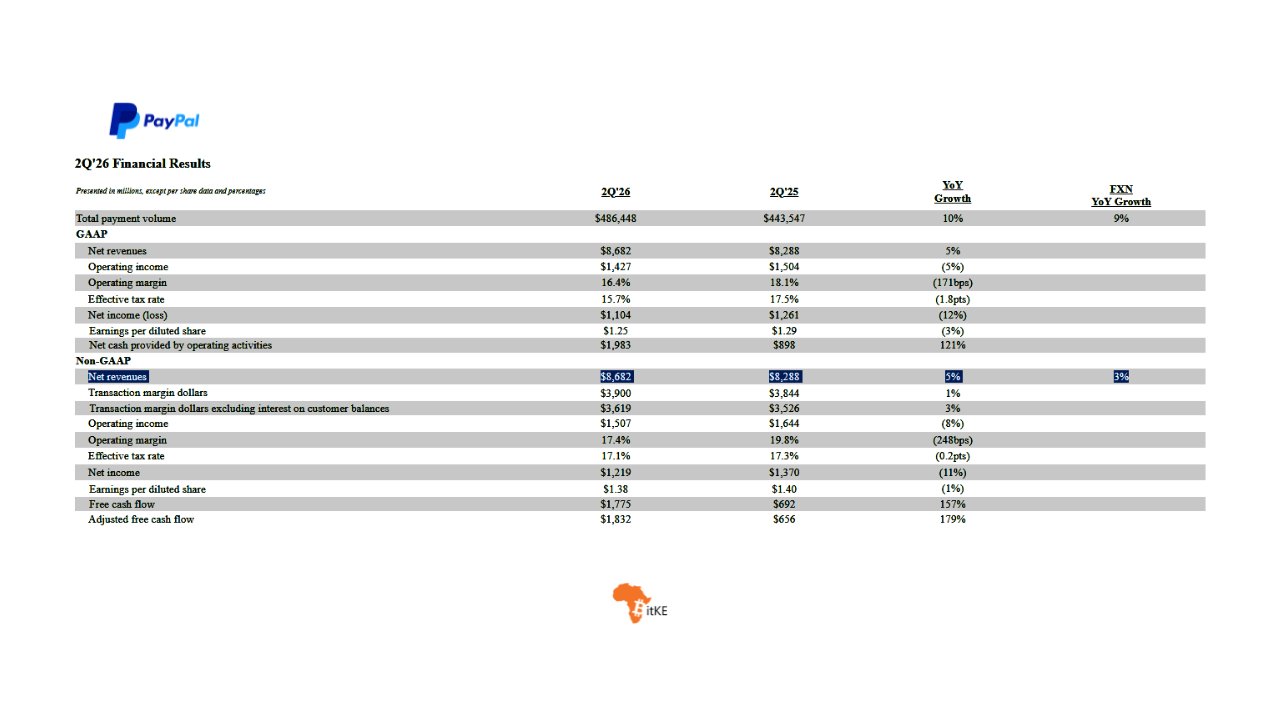
PayPal Q2 revenue exceeded expectations, highlighting PYUSD stablecoin as a key growth driver.
STABLECOINS | @PayPal Doubles Down on #Stablecoins as Revenue Beats Estimates in Q2 2026
During its Q2 2026 earnings update, #PayPal highlighted its dollar-backed stablecoin, $PYUSD, alongside AI-powered commerce tools as key growth initiatives.
Details: https://t.co/s7jkpx1lKy
#Stablecoins2026 #Stablecoins2026H1 #2026H1 #PayPalEarningsCall #PYPL
 0
0
153
0
0
153
2026-07-29 08:12
發佈後PYUSD走勢
看漲
PayPal Q2 revenue exceeded expectations, highlighting PYUSD stablecoin as a key growth driver.

Marco Salzmann 🇩🇪🇻🇪
Media
Influencer
A
3.0K @MarcoSalzmann80 極度看漲
PYUSD gets Kraken support on Stellar, and the Stellar ecosystem continues to grow.
🧵PayPal’s PYUSD continues expanding on Stellar.
PYUSD on @StellarOrg is now supported on @krakenfx.
It may look like a simple exchange listing.
In reality, it is another step in expanding the accessibility of one of the world’s largest regulated stablecoins. 👇
PYUSD is issued by @PayPal in partnership with @Paxos
Its expansion to @StellarOrg reflects growing confidence in the network’s ability to support fast, low-cost and production-ready digital payments.
Now, @krakenfx users can deposit and use PYUSD directly on Stellar.
This is not happening in isolation.
@StellarOrg has steadily become one of the strongest ecosystems for regulated digital dollars:
• USDC
• EURC
• PYUSD
• Native Circle CCTP
• MoneyGram Access
• Stripe’s Bridge operating in production via Airtm
Each addition strengthens the overall network.
The payment infrastructure is already being used at scale.
Through Airtm and Bridge, nearly 50% of enterprise payout volume flowed through Stellar during 2024.
More than $1.2 billion in stablecoin transaction volume was processed.
This is real‑world financial infrastructure, not a proof of concept.
Stellar is also becoming increasingly attractive for institutions.
Recent developments include:
• @MoneyGram joining as a Tier 1 validator
• Tradable bringing up to $1 billion in tokenized private credit
• Growing adoption across wallets, payment providers and exchanges
The ecosystem continues to mature.
What makes Stellar increasingly interesting is not a single partnership.
It is how each piece complements the others.
Stablecoins, tokenized assets, cross‑border payments, wallets and regulated financial services are all reinforcing the same network.
@krakenfx supporting PYUSD on Stellar is another building block in that strategy.
Each integration increases liquidity, accessibility and network effects.
The biggest stories are often not created by one announcement.
They emerge when many independent pieces begin fitting together.

Kraken Listings D
18.4K @krakenlistings PYUSD on @StellarOrg is now supported on Kraken.
Stellar is an open-source network built for fast, low-cost cross-border payments and tokenized assets.
Deposit now → https://t.co/xiqZWNzub1 https://t.co/Gq1oAruaG9
 108
1
2.9K
108
1
2.9K
2026-07-29 03:57
發佈後PYUSD走勢
極度看漲
PYUSD gets Kraken support on Stellar, and the Stellar ecosystem continues to grow.
價格預測
什麼時候是購買PYUSD的好時機?我應該現在買入還是賣出PYUSD?
在判斷現在是否是買入或賣出 PayPal USD (PYUSD) 的合適時機時,首先需要結合自身的交易策略和風險承受能力。長期投資者與短期交易者對市場信號的解讀往往不同,因此建議根據個人交易計劃做出決策。 根據最新的 PYUSD 4 小時技術分析,當前交易信號為持有。

Beacon預測
概率價格預測(未來24小時)Beacon預測免責聲明
當面頁面的數據結果基於當前交易對的實際交易數據(OCHLV)和相應的指標計算,然後進行分析得出結果。
此預測為實驗性技術產品,僅供參考,不構成投資建議。現實生活中的任何突發事件都可能對交易行為產生重大影響,因此交易者應謹慎決策。
此預測為實驗性技術產品,僅供參考,不構成投資建議。現實生活中的任何突發事件都可能對交易行為產生重大影響,因此交易者應謹慎決策。
關於 PayPal USD
PayPal USD (PYUSD) is a cryptocurrency launched in 2023and operates on the Ethereum platform. PayPal USD has a current supply of 2,769,836,737.1225352. The last known price of PayPal USD is 0.99970875 USD and is up 0.01 over the last 24 hours. It is currently trading on 177 active market(s) with $19,459,839.89 traded over the last 24 hours. More information can be found at https://www.paypal.com/pyusd.
查看更多
購買 PYUSD
交易 PYUSD