

The key shift: it’s not tokens that are competing, but payment stacks.
The winner won’t be the most high-profile launch, but the stack that can move money through the “fiat → settlement → money again” process with clear compliance and custody.
Rewards
Futures Daily Draw
100% Chance To Win With Daily Trades
Spot Daily Draw
Win 8,888 USDT In Grand Prizes
Mobile Top-Up
Top up mobiles easily, online, secure
Send
Send money globally, fast and secure
BitMart Mall
Live on crypto
PayPal USD Live Price data
Today's price of PayPal USD Is $ 0.99 (PYUSD/USD). With A Market Cap Of $ 2.77B USD. 24-Hour Trading Volume Of $ 54.73M USD, A 24-Hour Price Change Of +0.00%, And A Circulating Supply Of 2.77B PYUSD.
PayPal USD PYUSD Price History USD
Track the price of PayPal USD for today, 7 days, 30 days and 90 days
Period
Change
Change (%)
Today
$ 0
0.00%
7days
--
--
30days
--
--
90days
--
--
Own PYUSD Now
Buy and sell PYUSD easily and securely on BitMart.
PayPal USD Market Information
$ 0.99 24h Range $ 0.99
All time high
$ 0
All time low
$ 0
24h Change
0.00%
24h Vol
$ 54,728,394.74
Circulating supply
3.51B
PYUSD
Market cap
$ 3.52B
Max supply
3.51B
PYUSD
Fully diluted market cap
$ 3.52B
Trade PYUSD
PayPal USD X Insight

Aalexxx
Founder
Media
D
 3.5K @Aaleks_crypt
 Bullish
PYUSD's payment stack on Polygon will become the next winner in compliant payments.

CoinBlog D
327 @coinblogHQ PYUSD on Polygon, the Hyundai test (transfer in ~7 minutes), the Swift blockchain ledger, and Circle Bank with OCC approval-the market is assembling full-fledged payment stacks. https://t.co/xNWZBRA3IE
 2
2
 0
0
 28
28
2026-07-30 11:57
Trend of PYUSD after release
Bullish
PYUSD's payment stack on Polygon will become the next winner in compliant payments.

BitKE
Regulatory_Expert
Media
D
10.4K @BitcoinKE Bullish
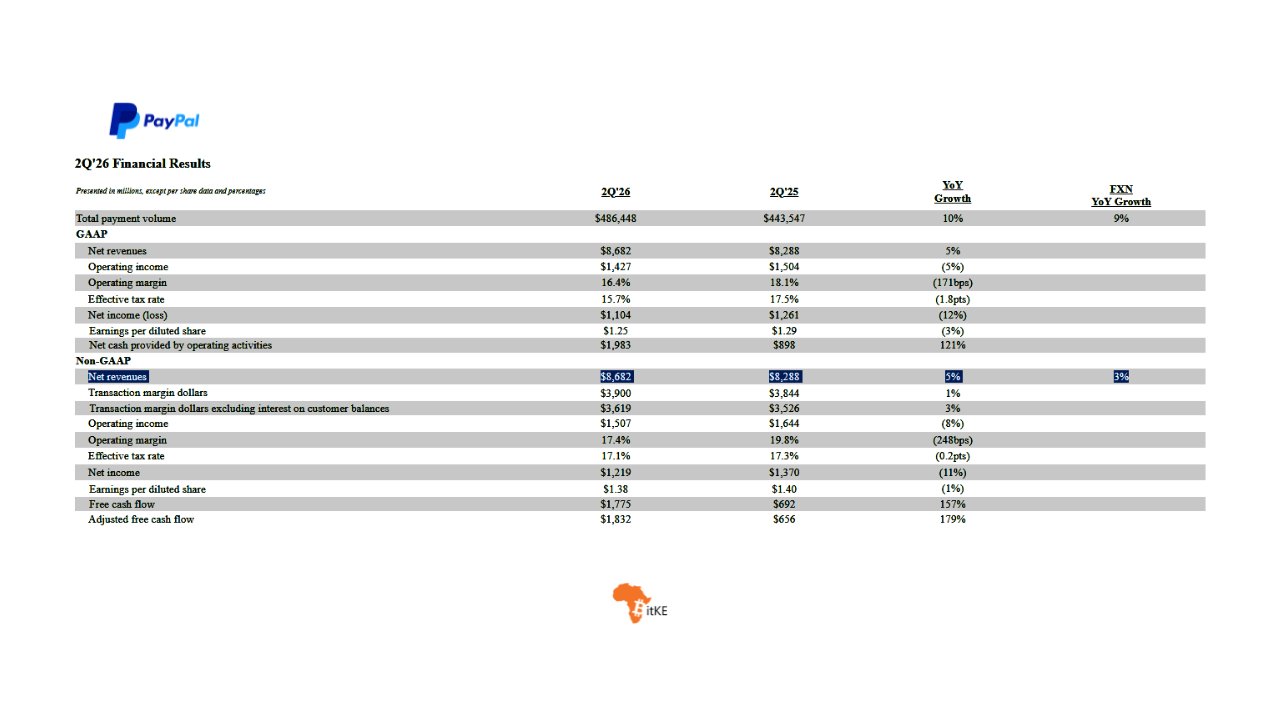
PayPal Q2 revenue exceeded expectations, highlighting PYUSD stablecoin as a key growth driver.
STABLECOINS | @PayPal Doubles Down on #Stablecoins as Revenue Beats Estimates in Q2 2026
During its Q2 2026 earnings update, #PayPal highlighted its dollar-backed stablecoin, $PYUSD, alongside AI-powered commerce tools as key growth initiatives.
Details: https://t.co/s7jkpx1lKy
#Stablecoins2026 #Stablecoins2026H1 #2026H1 #PayPalEarningsCall #PYPL
 0
0
153
0
0
153
2026-07-29 08:12
Trend of PYUSD after release
Bullish
PayPal Q2 revenue exceeded expectations, highlighting PYUSD stablecoin as a key growth driver.

Marco Salzmann 🇩🇪🇻🇪 Ħ
Tokenomics_Expert
Researcher
S
3.3K @MarcoSalzmann80 Extremely Bullish
PYUSD gets Kraken support on Stellar, and the Stellar ecosystem continues to grow.
🧵PayPal’s PYUSD continues expanding on Stellar.
PYUSD on @StellarOrg is now supported on @krakenfx.
It may look like a simple exchange listing.
In reality, it is another step in expanding the accessibility of one of the world’s largest regulated stablecoins. 👇
PYUSD is issued by @PayPal in partnership with @Paxos
Its expansion to @StellarOrg reflects growing confidence in the network’s ability to support fast, low-cost and production-ready digital payments.
Now, @krakenfx users can deposit and use PYUSD directly on Stellar.
This is not happening in isolation.
@StellarOrg has steadily become one of the strongest ecosystems for regulated digital dollars:
• USDC
• EURC
• PYUSD
• Native Circle CCTP
• MoneyGram Access
• Stripe’s Bridge operating in production via Airtm
Each addition strengthens the overall network.
The payment infrastructure is already being used at scale.
Through Airtm and Bridge, nearly 50% of enterprise payout volume flowed through Stellar during 2024.
More than $1.2 billion in stablecoin transaction volume was processed.
This is real‑world financial infrastructure, not a proof of concept.
Stellar is also becoming increasingly attractive for institutions.
Recent developments include:
• @MoneyGram joining as a Tier 1 validator
• Tradable bringing up to $1 billion in tokenized private credit
• Growing adoption across wallets, payment providers and exchanges
The ecosystem continues to mature.
What makes Stellar increasingly interesting is not a single partnership.
It is how each piece complements the others.
Stablecoins, tokenized assets, cross‑border payments, wallets and regulated financial services are all reinforcing the same network.
@krakenfx supporting PYUSD on Stellar is another building block in that strategy.
Each integration increases liquidity, accessibility and network effects.
The biggest stories are often not created by one announcement.
They emerge when many independent pieces begin fitting together.


Kraken Listings D
20.4K @krakenlistings PYUSD on @StellarOrg is now supported on Kraken.
Stellar is an open-source network built for fast, low-cost cross-border payments and tokenized assets.
Deposit now → https://t.co/xiqZWNzub1 https://t.co/Gq1oAruaG9
 108
1
2.9K
108
1
2.9K
2026-07-29 03:57
Trend of PYUSD after release
Extremely Bullish
PYUSD gets Kraken support on Stellar, and the Stellar ecosystem continues to grow.
Price Prediction
When is a good time to buy PYUSD? Should I buy or sell PYUSD now?
When deciding whether it’s a good time to buy or sell PayPal USD (PYUSD), it’s important to first align with your own trading strategy and risk profile.Long-term investors and short-term traders often interpret market conditions differently, so your decision should reflect your personal approach. According to the latest PYUSD 4-hour technical analysis, the current trading signal is Hold.

Beacon Prediction
Probabilistic Price Forecast (Next 24 Hours)Beacon Prediction Disclaimer
The data results displayed on this page are analyzed based on actual trading data (OHLCV) of the selected trading pair along with corresponding technical indicators.
This prediction is an experimental technical product and is provided for reference purposes only. It does not constitute investment advice. Unexpected real-world events may significantly impact market behavior. Traders should make decisions with caution.
This prediction is an experimental technical product and is provided for reference purposes only. It does not constitute investment advice. Unexpected real-world events may significantly impact market behavior. Traders should make decisions with caution.
About PayPal USD
PayPal USD (PYUSD) is a cryptocurrency launched in 2023and operates on the Ethereum platform. PayPal USD has a current supply of 2,769,836,737.1225352. The last known price of PayPal USD is 0.99970875 USD and is up 0.01 over the last 24 hours. It is currently trading on 177 active market(s) with $19,459,839.89 traded over the last 24 hours. More information can be found at https://www.paypal.com/pyusd.
Read More
Buy PYUSD
Trade PYUSD