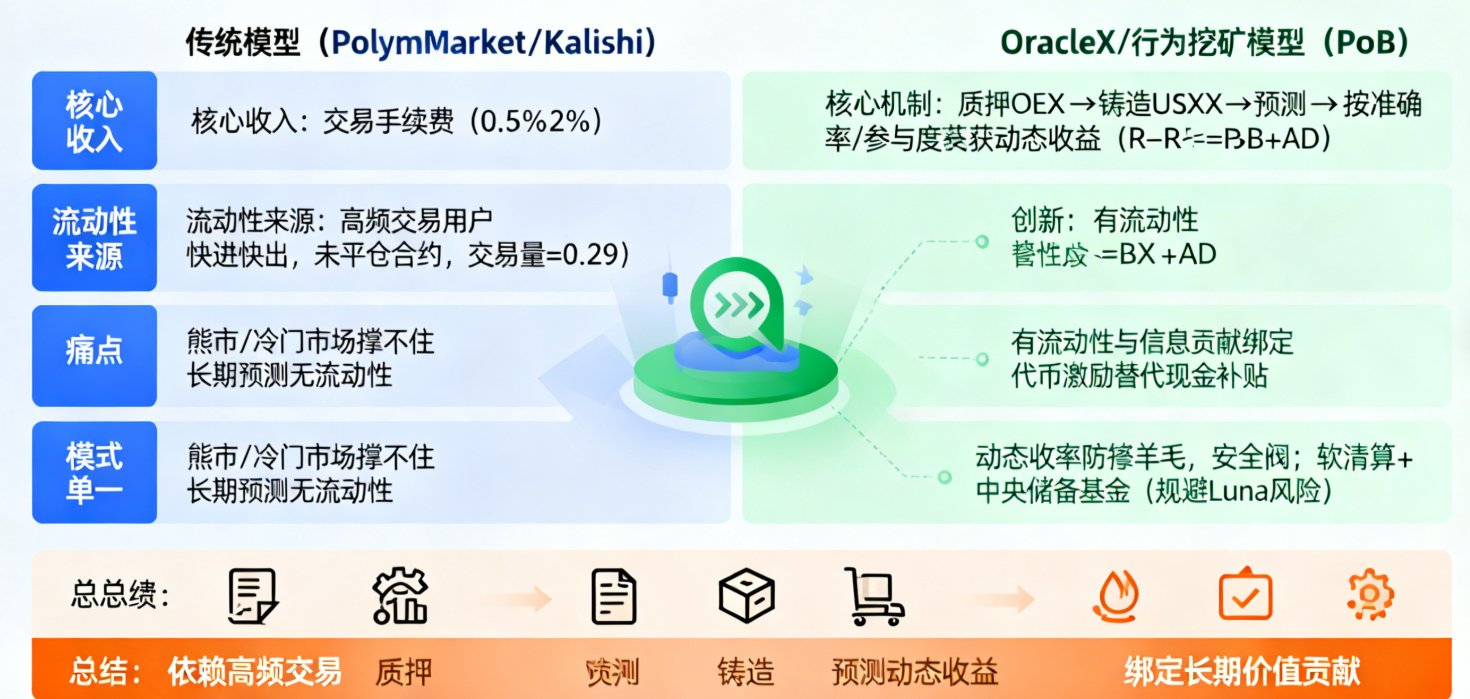
【Evolution of the Economic Model of Prediction Markets: From Fees to Behavior Mining】
Traditional prediction markets have a very single revenue model: taking a transaction fee (0.5%-2%).
Polymarket and Kalshi both follow this logic. The problem is that this model cannot sustain liquidity in bear markets or niche markets.
Look at the data: Kalshi's open interest to volume ratio is 0.29, meaning users flip quickly, and the platform can only earn fees from high‑frequency trading. But what about long‑term prediction events (e.g., "Who will be president in 2028")? Locking funds for years—who is willing to provide liquidity?
The industry needs a new economic model. OracleX's proposed "behavior proof" mechanism is worth attention:
Core logic: Users stake OEX → mint USDX → make daily predictions → receive dynamic rewards based on accuracy/participation → long‑term staking locks liquidity.
Innovations: ① Bind liquidity provision with information contribution; ② Replace cash subsidies with token incentives; ③ The yield formula (R_F = R_B + A_D) dynamically adjusts according to behavior quality, avoiding "free‑riding".
Whitepaper link: https://t.co/uS0MjseR63
Of course, the dual‑token model has the precedent of Luna's failure. But OracleX designed “soft liquidation” and a “central reserve fund” as safety valves. Whether it works needs real‑world testing.
Economic model innovation is the key for the second half. Relying solely on fees, prediction markets cannot reach a trillion‑dollar market cap.
#经济模型 #预测市场 #TokenEconomics #OracleX