 CRCL (CRCL)
- 77Индекс социальных настроений (SSI)- (24h)
- #48Рейтинг пульса рынка (MPR)0
- 18Упоминание в социальных сетях за 24 часа- (24h)
- 12%24-часовой бычий коэффициент лидеров мнений17 активный лидер мнений
- Краткое содержаниеCRCL stock price fell 16% due to Open USD competition, index exclusion, and the crypto bear market, with oversold technical signals appearing.
- Бычьи сигналы
- Oversold technical pattern
- Inverted hammer suggests a bottom
- Gap has been filled
- Institutions may be bottom‑fishing
- Market demand for stablecoins remains
- Медвежьи сигналы
- Open USD impact earnings model
- Zero-fee profit-sharing competition
- Index exclusion causing selling pressure
- Declining trading volume / selling pressure
- Overall crypto sentiment weakening
Индекс социальных настроений (SSI)
- Общие данные77SSI
- Тренд SSI (7 дн.)Цена (7 дн.)Распределение настроенийЧрезвычайно бычий (6%)Бычий (6%)Нейтрально (22%)Медвежий (44%)Чрезвычайно медвежий (22%)Инсайты по SSICRCL has high social heat (77/100) and full activity score (40/40), high KOL attention (27.5/30), but low sentiment (9.58/30), related to the 16% drop and competition pressure sparking discussion.
Рейтинг пульса рынка (MPR)
- Инсайт ОповещениеCRCL warning rank #48, social abnormality score is extremely high at 100/100, sentiment polarization only 17.3/100, KOL attention shift 19.5/100, primarily linked to the sharp price drop and competitive impact.
Посты из X
 BitKE Media Researcher D10.38K @BitcoinKE
#Circle ($CRCL) shares tumbled more than 17% after a consortium backed by some of THE BIGGEST NAMES in #payments, #banking, and #crypto unveiled Open USD, a new stablecoin designed to challenge incumbents such as ethereum:0xa0b86991c6218b36c1d19d4a2e9eb0ce3606eb48. @openstandard
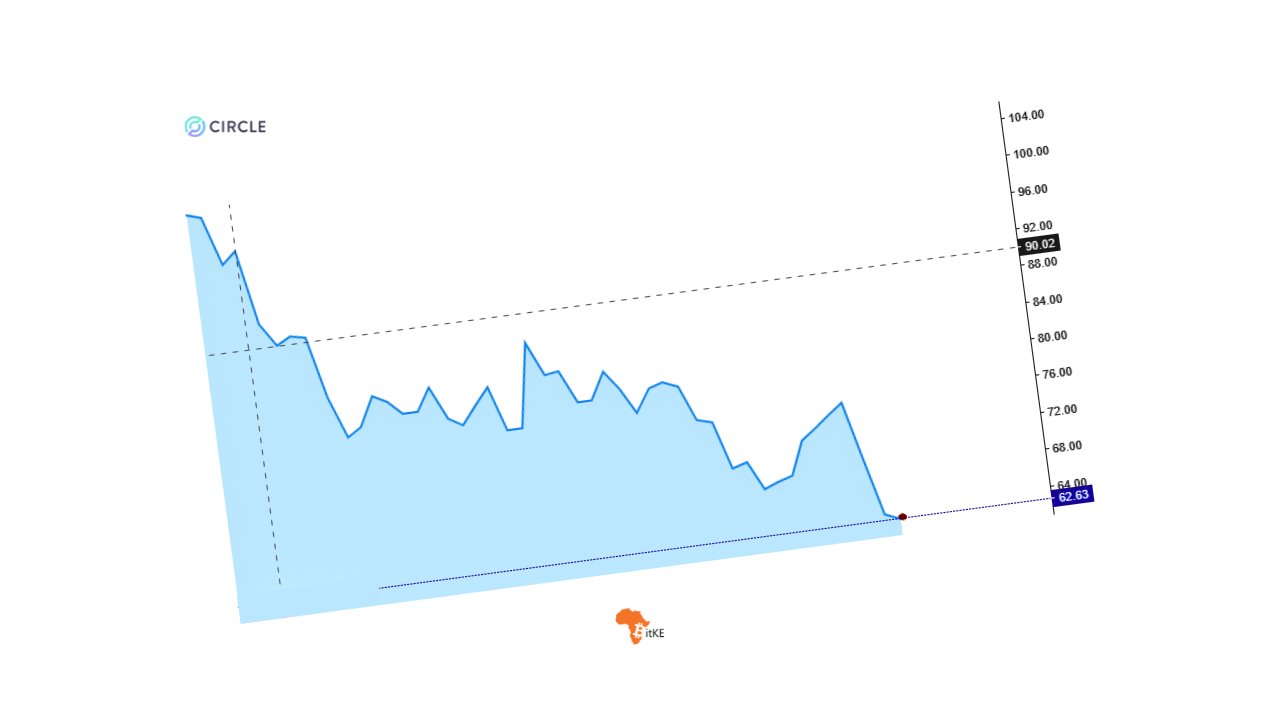 0 0 70 Оригинал >Тренд CRCL после выпускаЧрезвычайно медвежийCircle stock plummeted over 17% as the new stablecoin Open USD challenged USDC
 C J Quant Trader A23.12K @gch_enbsbxbs
First, the conclusion: CRCL can be bought. But you have to wait. Wait until no one is discussing this token. Wait until no one is discussing the crypto market. Just wait. If you can't accurately judge the timing and want to be overly cautious, then lower the expected price a bit. I don't want to discuss moats or similar concepts. I only look at a few points. Whether the price is attractive. (How low can it fall, how high can it rise?) (Reward-to-risk ratio) If the market comes, does it have the characteristics to generate FOMO sentiment? (Rebound strength)
7 3 956 Оригинал >Тренд CRCL после выпускаБычийCRCL has a buying opportunity, waiting for discussion to cool down before entry. 조드 Influencer Trader B4.20K @GreatZodd
 Masil 🇰🇷 D12.75K @sikiri0
: Is Circle really going bust 🥲 Open USD. With the emergence of $OUSD Yesterday Circle experienced a sharp drop. It might be appropriate to call it a crash. Since it fell more than 10% negative. Simply summarizing the reason for the crash A super‑large whale‑scale stablecoin company has emerged in the US stablecoin market that Circle dominates. Ultimately, the emergence of a new stablecoin - How much of a hit it will deal to Circle. - How much of the market pie it will take away. This part is crucial. First, because the price has already plummeted, the market appears to view it as a clear negative. But this wasn't something that was overlooked Since Circle also occupies a sizable portion of my crypto portfolio, I have considered the area where new stablecoin companies are emerging. My thoughts when buying were 1. Even if a new stablecoin arrives, it won’t definitively snatch away the pie that $USDC and $USDT currently hold. 2. Even if we lose some share, as the "stablecoin" sector itself expands dramatically, the loss is acceptable. 3. $CRCL’s compliance with U.S. regulations likely makes its trustworthiness the best among stablecoins. 4. Stablecoin trading is essential for AI‑driven agent trading, and that trade is already dominated by $USDC. 5. Even if the stablecoin side gets squeezed, in a Bitcoin rebound or bull market, Circle would likely deliver better performance. // I had considered these conditions, The American banking‑type companies I was constantly questioning : Will they simply hand the stablecoin dominance over to Circle? That question has finally been resolved. Especially, there are a huge number of companies participating in Open USD; everyone seems to know about it. : Stablecoins << This thing cannot be blocked. It’s a honey pot. Let Circle have this honey pot all to itself? Makes no sense. We absolutely have to get a share too That’s the only way. The stablecoin market will continue to grow year after year, and the more AI agents develop, the more it will be used. So even if we split the stablecoin pie, I think Circle’s position will still remain strong. Of course, as strong as we hoped…
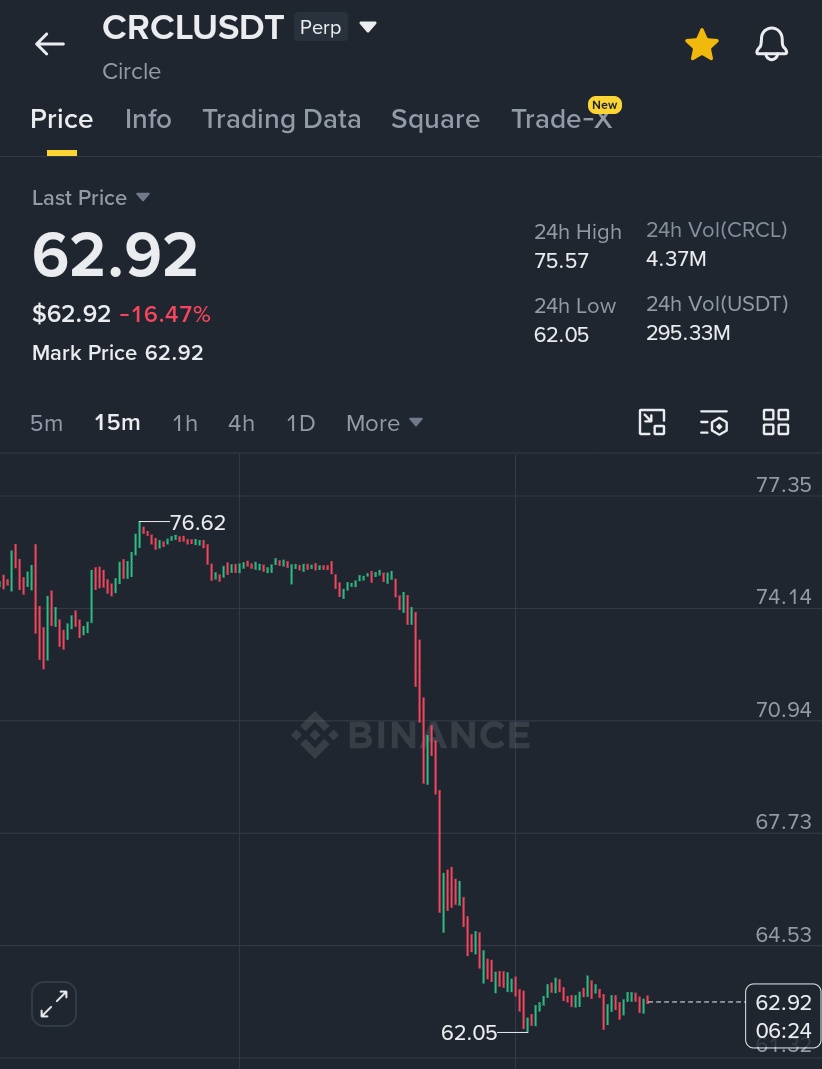 30 13 1.84K Оригинал >Тренд CRCL после выпускаНейтральноCRCL plunged more than 10% due to the emergence of Open USD, but the author believes Circle still has a long‑term advantage in the stablecoin market.
 TingHu♪ Influencer Educator C145.28K @TingHu888
It's back to the $CRCL lunch-foolish indicator phase. After a recent earnings report showed great performance (after all, it's a bull market performance in the crypto world), it quickly entered the impressive lunch phase. But will there be another earnings report rescue? To bet on a reversal, it's best to wait for the crypto market bottom.
44 9 7.04K Оригинал >Тренд CRCL после выпускаМедвежийCRCL's trend remains weak, suggest watching and waiting for a bottom reversal 吴说区块链 Media Educator D177.62K @wublockchain12
Wu reported that, according to Simply Wall St, Circle (NYSE:CRCL) was removed from several major Russell Growth Indexes in the Russell's annual reconstitution on June 26, including the Russell 1000 Growth Index, Russell 3000 Growth Index, and Russell Midcap Growth Index. This could cause institutions and passive funds tracking these benchmarks to reduce holdings of the stock, affecting its trading liquidity. Simply Wall St analysis notes that CRCL's stock price fell 32.8% over the past 30 days, reflecting selling pressure from the index reallocation. Additionally, following competitor Open Standard's launch of the alliance stablecoin Open USD, CRCL's stock fell to $62 today, a 16.55% decline over 24 hours. https://t.co/6rIg87sHPY
0 0 291 Оригинал >Тренд CRCL после выпускаМедвежийCRCL's stock price plummeted due to index exclusion and competitive pressure; recommend a wait-and-see approach. 赚_LCat Founder Educator S17.29K @Ryu_LCat
Back then many people were hyping CRCL; I said it’s not bad, but there’s no need to idolize it. The real barrier for stablecoins isn’t issuing tokens, but liquidity, compliant entry points, payment use cases, distribution capability, and ecosystem integration. Now giants like Visa, Stripe, Mastercard, Coinbase, and BlackRock are planning to jointly launch OUSD, which essentially validates my earlier judgment: Once the profit model of stablecoins is confirmed, traditional finance and payment giants will step in personally. This is a positive signal for the stablecoin industry, indicating the sector’s gold content is rising. But for a token like CRCL that the market has already priced in advance, it creates valuation pressure. So it’s not that stablecoins are unviable. It’s that the market previously over‑idolized CRCL. My view has never changed: Being bullish on the sector does not mean blindly chasing a single over‑priced token. The development of any thing requires time to settle repeatedly. Truly valuable opportunities are rarely priced in an instant; they are realized gradually through long‑term validation.
赚_LCat Founder Educator S17.29K @Ryu_LCatCRCL is certainly not bad, but there's no need for it to be continuously idolized. The stablecoin business, by nature, doesn't have high barriers. On top sits USDT, the liquidity heavyweight, holding its position for the long term. Below that, major exchanges are launching their own stablecoins, and even presidents are directly issuing them. Not to mention the traditional banking system, which, once a long‑term profitable model is confirmed, fully possesses the capability to issue its own. Looking at CRCL itself, a considerable portion of stablecoin profits still need to be shared with COIN. COIN itself serves as the core compliance gateway, handles ETF trading channels, captures stablecoin profit share, continuously expands its ecosystem, and enjoys favorable policy tailwinds. Even so, this round for COIN has only reached near a new high. In other words: Buying CRCL, the profit outlook for the next 3‑5 years, the market has already priced in a range, which is the stretch from the bottom to the new high. What remains is mostly time exchanging for space, and time is often just a grind. Most participants may not see the redemption logic realized, and their patience is already worn down by volatility.
32 9 2.72K Оригинал >Тренд CRCL после выпускаБычийStablecoin sector favorable, CRCL valuation pressure, recommend watching BITWU.ETH 🔆 FA_Analyst Educator D375.19K @Bitwux
🧐 What is Circle falling from? Does its moat still exist? First, the result: I believe $CRCL is oversold in the short term; if market sentiment drives further overselling, I would consider buying a portion, However, I currently lack the confidence to hold it long term and may need more observation. Because the fundamentals and moat have clearly undergone massive changes, which I detail below! I've been pondering a question: What exactly constitutes a true moat for a company? Today, the stablecoin sector Open Standard announced the launch of Open USD, a new stablecoin backed by over 140 companies including Visa, Stripe, Mastercard, BlackRock and Coinbase. Investors are assessing the competitive threat it may pose to USDC. The resulting sharp decline is a compelling topic to consider regarding moats! 1️⃣ What exactly is $CRCL falling from? Open Standard officials state that Open USD is designed as follows: Enterprises can mint/redeem at zero cost with no manual scale limits; partners receive the reserve asset earnings of Open USD after a small management fee; governance is jointly decided by the independent company Open Standard and a partners' board. The participant list includes many payment, finance, technology, and crypto infrastructure firms such as Visa, Stripe, Mastercard, American Express, BlackRock, BNY, Google, Shopify, Coinbase, Solana, Base, Ripple, etc.; Stripe also publicly stated that Open USD will be the default stablecoin for Stripe's business users; The implication is clear: Open USD is not attacking USDC via technical parameters, but through allocation mechanisms. Circle's core profit pool comes from reserve asset earnings; Open USD's core slogan is to return a larger share of that revenue to traffic‑generating partners. In other words, OUSD intends to share the economic benefits previously captured by Circle with Visa, Stripe, Shopify, Coinbase, banks, wallets, exchanges and merchant ecosystems to quickly acquire users. The "USD 1:1 + on‑chain transfer" technology of stablecoins is not the deepest moat; the true moat lies in trust, regulation, liquidity, distribution, integration, use cases, and economic incentives. Now the wolf is here, and another possibility emerges. Thus, I think the representative point here is: A single technology is not a moat; the ability to continuously translate it into irreplaceable products and profits for customers is the moat. I have discussed this theme many times with friends; Buffett rarely invests in tech firms, preferring consumer staples, because he understands how quickly moats in tech can change. 2️⃣ Has Circle's fundamentals changed? Actually, no! USDC has not lost its peg due to today's news, nor has Circle's reserve shown any sudden issues. Circle CEO Jeremy Allaire @jerallaire posted on X that USDC remains the "most trusted, most widely adopted, and best institutional‑ready stablecoin globally." He said Circle will continue expanding its ecosystem among banks, payment firms, capital market companies, and enterprises, while providing partners more ways to become "economic stakeholders" in USDC network growth. Additionally, Circle's Q1 2026 report shows USDC ending circulation of $77 billion, up 28% YoY; Q1 on‑chain USDC transaction volume of $21.5 trillion, up 263% YoY; Q1 total revenue and reserve revenue of $694 million, up 20% YoY; adjusted EBITDA of $151 million, up 24% YoY. DeFiLlama currently shows USDC market cap around $73.88 billion, still the second‑largest stablecoin; But where did the change happen? Why such a drop? Because expectations of fundamentals have clearly shifted. Stock pricing looks beyond today's earnings to future cash flows, growth rates, profit margins, and moat durability. In 2025, 96% of Circle's revenue came from reserve income; its 10‑K states reserve income is driven mainly by stablecoin circulation and reserve yield. This means any factor affecting USDC circulation, reserve‑earnings sharing ratio, or partner bargaining power will impact CRCL's long‑term value. 3️⃣ Is the moat still there? Yes, but re‑priced. I've heard many analyses of Circle's moat, and my own study leads me to think it has at least four layers: The first layer is trust and regulatory brand. Circle's USDC reserves are largely held in the Circle Reserve Fund, managed by BlackRock and custodied at BNY; Circle also discloses transparency reports on reserve assets. This is important for institutional clients, especially as the U.S. regulatory framework becomes clearer. The second layer is existing liquidity and network effects. USDC already has hundreds of billions of dollars in circulation, numerous trading pairs, DeFi integration, on‑chain wallets, enterprise APIs, and developer familiarity. Stablecoins cannot be fully replaced by downloading an app; many use cases depend on deep liquidity, trading pairs, risk controls, accounting, compliance, and upstream/downstream integrations. Circle's Q1 disclosed USDC accounted for 63% of stablecoin transaction volume that quarter, indicating strong usage. The third layer is operations and banking infrastructure. Issuing a stablecoin is not trivial; it involves minting, redemption, reserves, audits, compliance, banking relationships, on‑chain security, cross‑chain, blacklists, and regulatory requirements. Circle partnered with Coinbase in 2018 to launch USDC, and in 2023 updated the agreement granting Circle sole governance of the stablecoin network; Coinbase continues to support USDC in deposits/withdrawals and client products, while Circle pays Coinbase a share of net reserve income. The fourth layer is platformization attempts. Circle aims beyond being just a USDC issuer; it also builds infrastructure like Arc, CPN, Circle Wallets, Gateway, Agent Stack, USYC, etc. In Q1 2026, Circle reported CPN's annualized volume around $8.3 billion and continued launching Managed Payments and other products. If these become indispensable "financial operating systems" for enterprises and developers, Circle's moat will thicken. But the issue is clear: these moats are mostly strong usage inertia, not strong pricing power. Understanding this sentence is crucial! It means stablecoin users ultimately want cheap, reliable, redeemable, compliant, and integrable solutions. Merchants aren't necessarily loyal to USDC, payment platforms aren't either, and exchanges can support multiple coins. Open Standard's approach pulls all distributors in, turning them from "help Circle distribute USDC for a cut" into "co‑own a stablecoin network and share reserve earnings." This weakens Circle's bargaining power over channels. Thus Circle's moat remains, but it shifts from a "wide moat" to a "moderate moat + high competitive pressure." It is not a Coca‑Cola type brand that consumers naturally choose daily, nor an Apple‑like hardware‑software ecosystem lock‑in. It's more akin to an early financial infrastructure platform: it has first‑mover, trust, scale, and compliance advantages, but once large distribution channels unite, the profit pool gets re‑allocated. 4️⃣ Why is the market reaction so large? Because the news directly attacks CRCL's three most sensitive variables: USDC circulation, net split rate, and ultimate profit margin. Circle's business formula can be simplified to: Profit potential ≈ USDC circulation × reserve yield × Circle retention ratio − operating costs Circle disclosed that a 100‑basis‑point rate drop, under the assumed 2025 scale, could reduce reserve income by about $756 million and cut distribution and transaction costs by about $369 million; This implies a multi‑hundred‑million‑dollar impact on net economic benefit, showing CRCL is highly sensitive to rates and stablecoin scale. Open USD may not immediately steal USDC balances, but it will lead investors to assume that Circle may need to give larger splits to retain distribution channels; to enter ecosystems like Stripe, Shopify, Visa, Mastercard, Coinbase, Circle may be unable to maintain its previous reserve‑earnings retention model. Open Standard officials explicitly state that partners will receive Open USD reserve earnings after a management fee. This essentially tells the market: The stablecoin profit pool may shift from exclusive issuer ownership to shared distribution network. 5️⃣ Is Circle a "good business"? Circle has an advantage: its domain is massive. Money transfer, settlement, cross‑border payments, on‑chain finance, AI‑agent payments are huge markets. If stablecoins become new financial infrastructure, the industry is inherently significant. But it has a flaw: it's not a stable consumer‑to‑consumer (ToC) necessity, but a heavily B‑to‑B, channel‑driven, regulation‑intensive, partner‑competition infrastructure business. Reuters also noted in this news that stablecoins are still primarily used for crypto token trading and have not yet been widely adopted for everyday payments. This means Circle hasn't built the stable consumer habits of Coca‑Cola, P&G, or Apple; it relies more on exchanges, wallets, payment firms, banks, merchant platforms, and developers. Over‑reliance on the B‑side may be its biggest weakness. Now the issues I see: 1) Technological moat: not deep enough. Issuing a USD stablecoin has a non‑zero technical barrier, but it's not uncopyable. OUSD can directly use chains like Solana, Base, Stellar, Polygon and existing payment infrastructure. The real challenges are compliance, liquidity, redemption, risk control, distribution, and trust—not the token contract itself. 2) Product and brand moat: exists, but not at consumer‑brand level. USDC holds a "compliant, transparent, reliable" brand among institutions and developers, one of Circle's biggest assets. Yet at the payment endpoint, many users don't care whether the underlying rail is USDC, OUSD, or another USD token; they care about speed, low cost, convertibility, and safety. Open Standard participant Félix also said customers don't care which rail the money moves through, but whether their families receive local currency quickly, reliably, and at fair cost. 3) Capital and regulatory moat: present, but being replicated. Circle's reserve management system, BlackRock, BNY, regulatory compliance, and transparency are advantages. However, Open USD's partners also include BlackRock, BNY, Standard Chartered, Visa, Mastercard, Stripe, etc. When these heavyweight institutions unite, Circle's "more institutional, more compliant" edge remains but is no longer the sole option. Thus my personal conclusion is: Circle is a strong early mover in a good sector, but because fundamentals have changed, it is not yet proven to deliver long‑term high ROIC, strong pricing power, and weak competitive erosion; I may not take a heavy short‑term position. 6️⃣ Outlook: After Open USD launches within the year, its reserves, compliance, chain support, developer experience, secondary market liquidity, and actual merchant usage will take time. Many partners are merely "supporting/exploring" and may not immediately shift core fund flows. Circle maintains USDC above $70 billion, RLDC margin stable, and platform revenues (Arc/CPN/USYC) growing; the market may view today’s drop as sentiment‑driven. I think for a long period, USDT will continue to dominate offshore and trading scenes, while USDC will remain dominant in compliant DeFi, institutions, US crypto ecosystem, and certain enterprise scenarios, Then OUSD may penetrate Stripe, merchant settlement, cross‑border payments, and platform economies. Circle can still grow, but valuation multiples may decline as it ceases to be the "sole compliant entry" and becomes one of multiple infrastructure providers. If you still hold this asset, I think you should watch: 1) USDC circulation and market share: if USDC only sees a stock price drop without on‑chain scale decline, it's sentiment; if supply and share continuously outflow, it's a fundamental shift. 2) RLDC margin: Circle's 2025 RLDC margin is 39%. If this ratio falls markedly to retain channels, it indicates the moat is being eroded by channels. 3) Coinbase's actual moves: Coinbase is both Circle's core partner and present in the Open USD ecosystem. Circle's 10‑K shows Coinbase supports USDC usage, and Circle pays Coinbase a share tied to USDC net reserve income. If Coinbase's support for OUSD shifts from "an additional option" to "the default choice," that would be detrimental to Circle. 4) Whether Stripe's default stablecoin actually brings balances: Open Standard cites Stripe stating Open USD will become the default stablecoin for Stripe's business users. However, investors should look at actual balances, settlement volume, and merchant usage, not just announcements. 5) Whether Circle's non‑reserve income can ramp up: In 2025, 96% of Circle's revenue came from reserve income; if Arc, CPN, wallets, developer tools, USYC, and payment services don't become sizable revenue streams, Circle remains highly dependent on rates and USDC circulation. 6) OUSD reserve transparency and regulatory structure: If OUSD's reserves, audits, redemption, and regulatory oversight are sufficiently clear, it poses a greater threat to Circle; if these issues are vague, USDC's trust moat will continue to play its role. 7️⃣ Conclusion: My assessment: CRCL's drop today has a sentiment component, but fundamentals have indeed changed. If you hold it, even a small portion like me, you should analyze and think carefully to decide your next move. Respect your wealth, and wealth will respect you! Overall, in the short term, OUSD hasn't launched yet, and Circle's USDC size, transaction volume, reserve system, and enterprise products haven't deteriorated immediately. So amid an over‑reaction, don't panic; best to observe first, Long term, OUSD's emergence precisely targets Circle's profit pool and moat: it makes the market realize that stablecoin issuers may struggle to monopolize reserve earnings, and payment companies, exchanges, banks, and merchant platforms that control distribution and use cases will demand a larger share of economic benefits. Thus, while Circle's moat remains, it shifts from a high‑profit platform to one that must prove it is not a replaceable financial conduit. This is a challenge; if Circle can elevate USDC's trust and liquidity into an integrated platform encompassing Arc, CPN, enterprise payments, APIs, and compliance networks, it still has a chance to be a long‑term winner. Conversely, if it continues to rely mainly on issuing USDC for reserve earnings, alliances like Open USD will continuously compress its valuation and margins, and other stablecoins may emerge to capture market share.
BITWU.ETH 🔆 FA_Analyst Educator D375.19K @BitwuxMarket uncertainty means you never know when a sudden blow will strike. Although the exact direction of the alliance stablecoin is still unknown, the current show suggests they are waiting for Circle to be ready before they start picking the fruit. Users need not worry about which stablecoin is usable; early promotions will attract agents and users, and the barrier gets broken. Those who bought $CRCL at high levels are now facing their first darkest moment! https://t.co/zee2VDXQsS
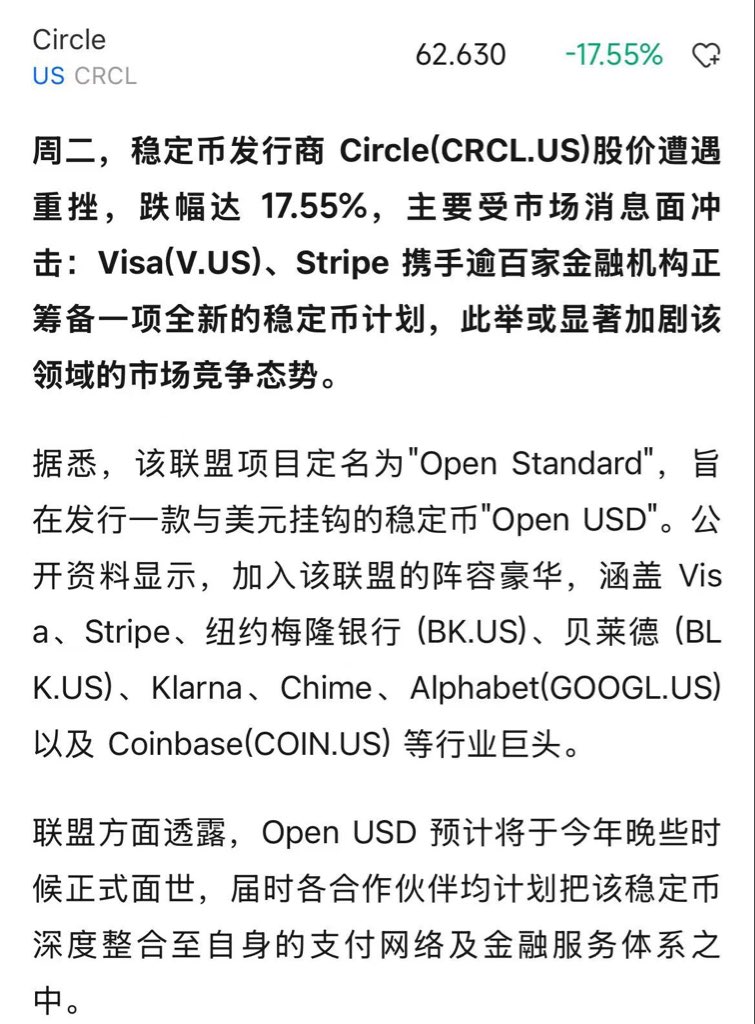 25 24 9.02K Оригинал >Тренд CRCL после выпускаМедвежийCircle faces competition from Open USD, stock price plummets, long‑term moat challenged, but could be oversold in the short term and worth watching.
 小熊饼干 . var⛵ TA_Analyst Trader A52.42K @Airdrop_Guard
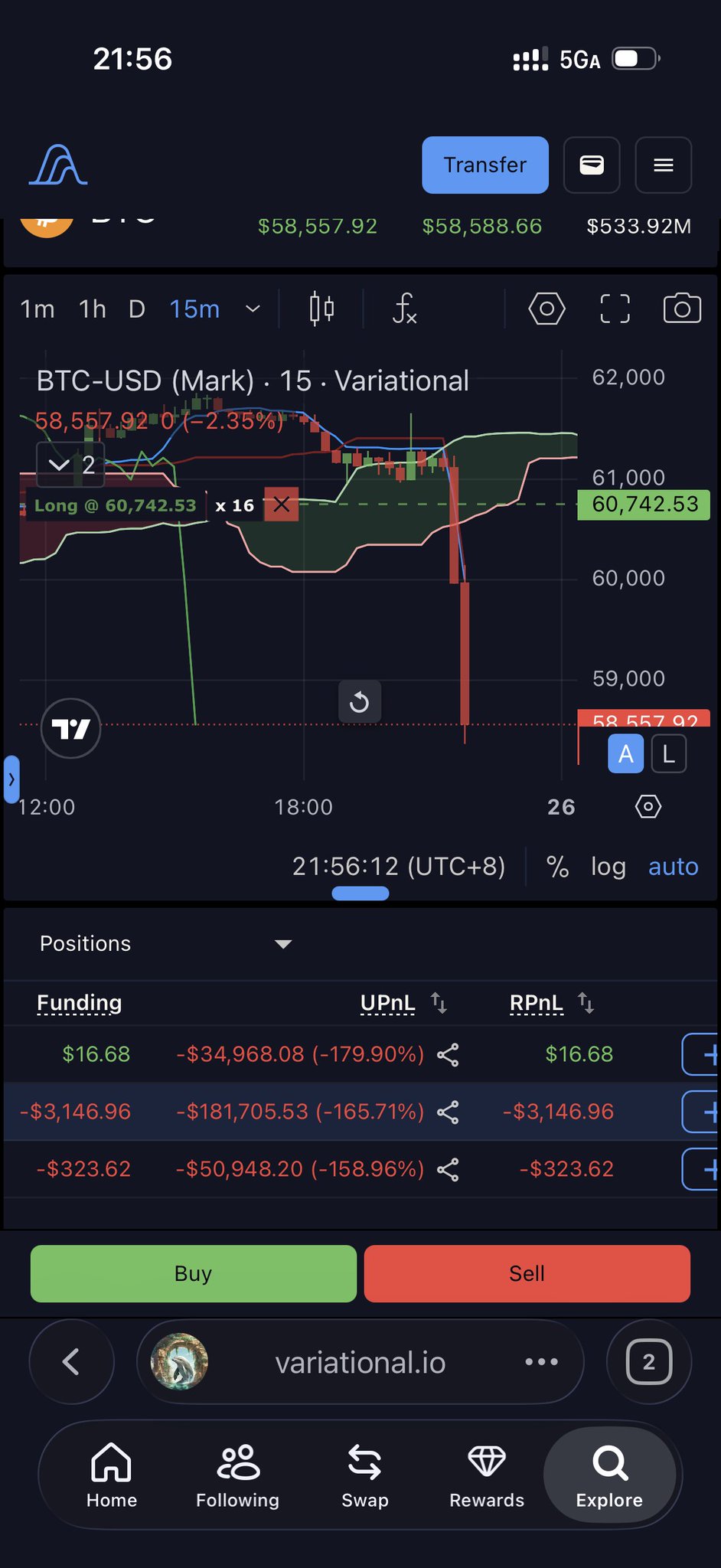
I lost $180,000 in CRCL, which is about ¥1.26 million RMB, in just 3 days. I'm truly devastated. Bought at 82, then added to lower the cost, bought 1.2 million U, and on Thursday night at 9:30 the market opened and it crashed again. Seeing the K‑line chart broke me; in just three trading days it fell that much—damn it, it was BTC with 4× leverage. Everyone else’s big cake (i.e., Bitcoin) rebounded, but this trash CRCL still dropped 18%. That night I cut my losses at 69.2 and the next day it bounced back 10%; I don’t regret exiting. Yesterday I saw a plunge of 17.55%—damn, US stocks are so brutal. In summary, I blame myself for venturing into an unfamiliar field. I’m inexperienced, I’m an idiot.
 小熊饼干 . var⛵ TA_Analyst Trader A52.42K @Airdrop_Guard
https://t.co/vIEXDFJn1f
71 93 43.21K Оригинал >Тренд CRCL после выпускаЧрезвычайно медвежийThe author incurred a massive loss of $180,000 in CRCL trading, feeling extremely pessimistic and self‑blaming. IncomeSharks TA_Analyst Trader C744.60K @IncomeSharks
Odds dropped 10% today on the Clarity Act passing this year on the same day $CRCL drops double digits on news of a new stable coin (OUSD). All while Bitcoin is trying to find support. Crypto could use some direction right now outside of more memes being the solution. https://t.co/JweimG6wfk
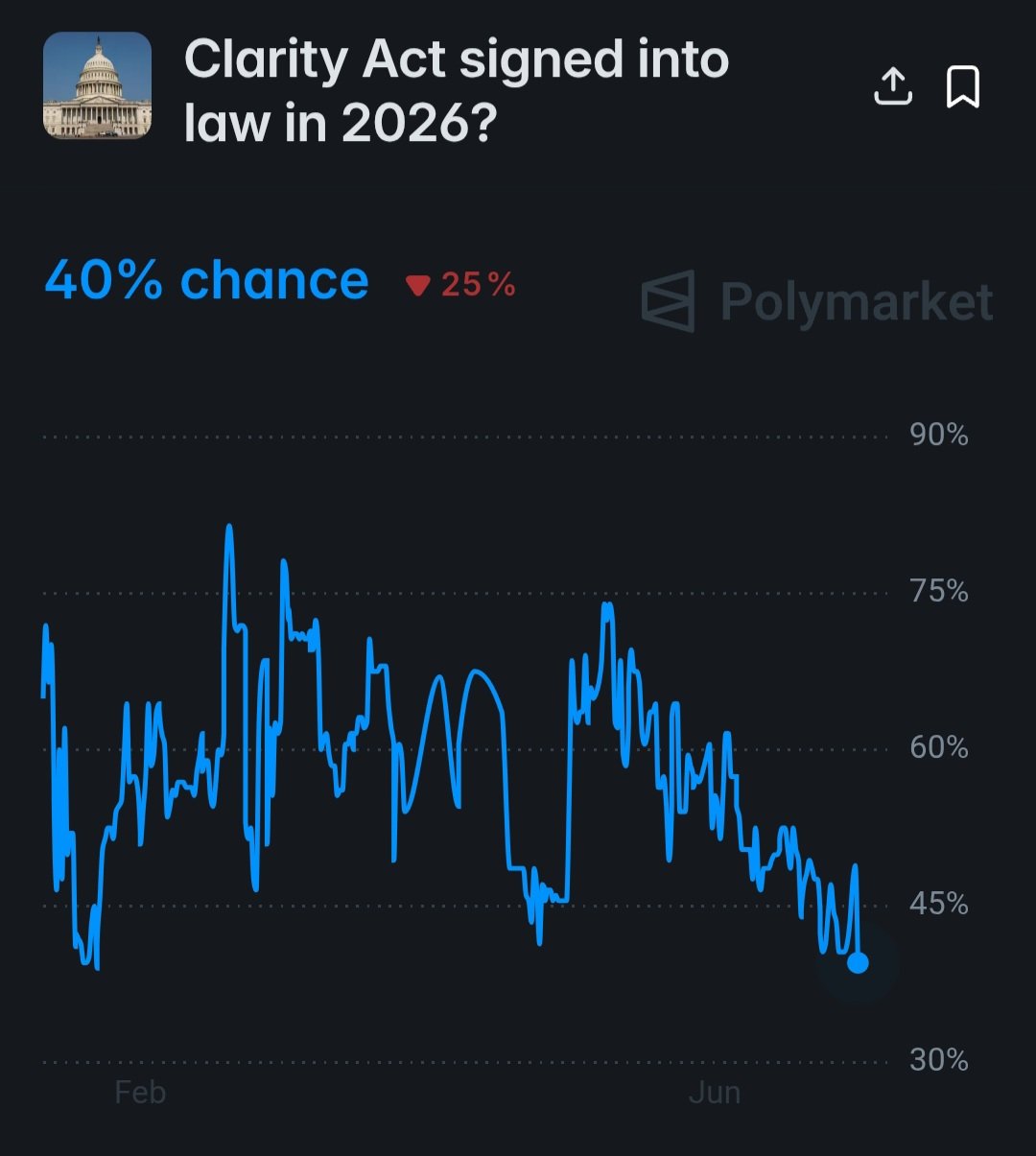 218 27 42.48K Оригинал >Тренд CRCL после выпускаМедвежийCRCL plunged due to news of a new stablecoin, Bitcoin is seeking support, and the market lacks direction amid regulatory uncertainty.
 大宇 FA_Analyst Educator C312.71K @BTCdayu
$CRCL back above $60, a few thoughts: 1. CRCL is like Tesla, stablecoin compliance is like open source. After open sourcing, anyone can make electric cars, but it’s best for Tesla, because only then people develop a habit of using EVs, the whole market grows faster, and in a larger market each person finds their niche and takes a piece—some focus on large TV sofas, others on FSD. 2. Even the best projects shouldn’t be all‑in—what matters is not how you view it, but how the market views it. 3. Moats have to be built; whether you can overcome them is only known by walking the path—but they must be built. I think challenging USDC is not easy. 4. Value investing relies on holding, but why is holding hard? Because various challenges and uncertainties always arise. 5. The level of skill in investing is about how you think and act in the toughest times—everyone must own the cost of their choices. 6. CRCL faces three future challenges: 1) New stablecoins will keep emerging, some targeting the B‑side, some from investment banks; in the open market, USDC remains the largest compliant player. 2) CB’s revenue share will persist long‑term—if CB wants to push new ones, that’s better; renegotiate agreements. If not, you keep helping expand USDC’s share and get a cut. 3) The ultimate benefit will be how much compliant B‑side USDC can capture—but we should assume it won’t capture much; the main focus is the C‑side and open market, which currently is hard to rely on in crypto, followed by trading and prediction markets. The most important variable for growth is which stablecoin will be used for compliant US‑stock on‑chain solutions; theoretically none is mandated—USD1 could be used—but ultimately it depends on user choice. This is a mid‑term variable worth watching.
168 85 42.35K Оригинал >Тренд CRCL после выпускаНейтральноCRCL back to $60, facing stablecoin competition and compliance challenges


